Season 5 · Episode notes
ep. 503 - AI Inception
Welcome to Episode 503 of The Primitive Intelligence Podcast. In this riveting installment, we delve deep into the recent Senate hearing on AI, dissecting the key takeaways and implications for our technological future. Tune in for an exclusive interview with ChatGPT, where we explore the frontiers of artificial intelligence and its evolving role in our lives. Join us as we critically examine the prevalent notion of AI's potential to dominate the world, separating fact from fiction in this captivating discussion.
Episode description written by ChatGPT.
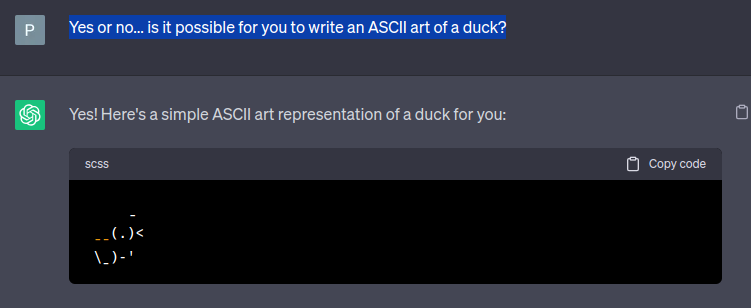
ACSII Duck Drawn by ChatGPT
- Open AI - ChatGPT: https://openai.com/
- AutoGPT: https://autogpt.net/
- Amazon Polly: https://aws.amazon.com/polly/
- Senate AI Hearing - YouTube: https://www.youtube.com/live/TO0J2Yw7usM?feature=share
- IBM Watson plays Jeopardy!: https://youtu.be/P18EdAKuC1U
Music:
Track: "Techtopia"
Music provided by https://Slip.stream
Free Download/Stream: https://get.slip.stream/BUhV9z
Track: "All Is Well"
Music provided by https://Slip.stream
Free Download/Stream: https://get.slip.stream/9JfPwP
Track: "Premier Combine"
Music provided by https://Slip.stream
Free Download/Stream: https://get.slip.stream/80qz6C
Read the transcript
You are listening to the
Primitive Intelligence Podcast,
episode 503.
Today, we shift our focus
towards the perils that lurk
within the realm of artificial
intelligence.
Delving into depths is ever
evolving technology, we uncover
the singular pronouns of Ai's
dark side, exploring the ethical
dilemmas, privacy concerns, and
a potential loss of human
autonomy.
Prepare to be captivated as we
navigate through the treacherous
terrain of Ai's pitfalls and
shed light on the imperative
need for responsible development
and regulation.
That's that's one heck of an
intro.
I'm going to be completely
honest with you.
I had a I write that.
Interesting.
My research took me a different
direction than I was expecting.
So we're going to look into
this.
I was originally planning on
this to be a little bit more of
a fun exercise and looking at a
I and it turned into another
another round of me watching an
congressional hearing.
So we can go into that, I guess.
There's really nothing to do but
to get into it.
The primitive intelligence
podcast a I Inception starts now
Artificial Intelligence.
It's not new.
It's well known now.
It's more well known now than it
has been for quite some time.
And there's a lot of talk about
how a I is going to either
revolutionize or destroy the
world.
The first things that pop into
people's minds when you hear
artificial intelligence are
things like Skynet or The
Matrix.
I'm going to lose my job to AI
and it's evolving faster and
faster and we can't keep up with
it.
And that I was going to kind of
look at that side of it and
that's why I start looking at
initially.
But then it took a whole
different turn.
I started around with ChatGPT
and auto GPT.
I've been using Da Vinci to come
up with the artwork for the
episodes for this for primitive
intelligence as well As for hike
files for the season, and what I
was learning is it's helpful,
it's interesting, but it is far
from perfect.
Now for the the artwork, the
text to art, some of that is
really good and some of it's
just garbage.
Depending on how well you prompt
it, it can be better.
But sometimes you can use the
same prompt and just tell it to
recreate and recreate and
recreate and it you might it
might show you 15 different
pictures and only one of them is
really any good.
So it's not it's not perfect by
any stretch of the imagination.
Now I'm talking all consumer
grade AI.
You know what you can get on
your phone or on a on a website.
I'm sure big corporations have a
lot better computing power, you
know, and they're able to do
better things.
Now when you really think about
it, A I in our lives has been
around for over a decade easily.
If you think Siri is basically
an A I.
Before Siri, Google had what was
called Voice Actions.
Trying to remember how far back
that went.
I think like Android 2.0, I
think is when they first
launched.
I don't know if it was on
Android One, but it wasn't.
It didn't talk back to you.
It wasn't very interactive, but
you could hit a button on your
phone and say take a note or
note to self, send an e-mail,
open this app and it would do
it.
It wasn't fantastic, but it
would, it would do it.
So in a way that was kind of the
forerunner of A I I'm sure I'm
missing something.
So if you're if you're really
into the A I and you're like no,
there was this one that was back
in the 70s.
I'm sure there was something
before that, but I'm talking
consumer facing What you would
have in your hand that was
probably and it wasn't even all
that smart, it wasn't really an
A I, but it was kind of the lead
up to what we have now.
When you look at Siri and you
look at all these different
apps, Google Assistant and Alexa
and Nest and all these smart
devices, these are little baby
steps in a I.
And now you've got these large
language models like ChatGPT and
Google's Bard.
And well, here's another one.
You remember IBM's Watson played
Jeopardy was a contestant on
Jeopardy that was a a one of the
early a i's and that was a
fairly advanced early a I.
But they're not they're not
perfect in looking at things
like ChatGPT and all these
things that I thought there's
such a spread when you see in
reality how these things
actually operate.
Now that opening that I had Auto
gpt create I I also had ChatGPT
try to create 2.
I did I did 4 different ones.
Now I'm not going to read them
all.
Auto GPT is based on ChatGPT.
It's just got plugins in some
different modules and allowed to
do different things.
The problem I was having with
the with the 1st 3 instances was
that it just wanted to as soon
as it heard.
As soon as you put in podcasts
it almost assumed multiple hosts
and I know a lot of podcasts
have more than one host.
So everything was we and us and
you know join us and as we and
all that.
And I had the third one, which I
I kind of like the wording to
and I I told it to recreate it
but to use singular pronouns.
And it rewrote it to what I read
in the beginning but it actually
I almost took it out because I'm
like well, that that I could say
this without it sounding weird.
This is we uncover the singular
pronouns of Ai's dark side.
It makes zero sense.
And that is part of the problem
with AI is it doesn't always
give you truthfulness.
But then again neither do people
ChatGPT in these the current
what they call generative Ai's
my my notes from everything I I
test it over the past few days
you think I have a ton of notes.
I've got one line interesting
and helpful to an extent, but
its database is limited.
Meaning it's not real.
It can't generate anything on
its own.
It has to go to this database,
so you do get a lot of
repetitiveness.
These four leadins for the
podcast are all very similar,
even though they're done with
two different AIS based on the
same models.
But it's all very similar.
And I gave it a pretty vague,
you know, prompt.
Just create an opening for a
podcast that's talking about the
dangers of a I.
That was it.
I didn't.
The the last one I said, you
know, using singular pronouns
and I told it to start with.
You are listening to the
Primitive Intelligence podcast.
But I mean, it's interesting.
I wouldn't have written anything
like that.
I wouldn't have started the
podcast like that.
So it really has.
No imagination.
Which it's a I.
So you wouldn't think that it
would have imagination.
Is it ready to take over the
world?
Not in its current form, but in
thinking that that's why I start
to go towards the idea of let me
get together some of these
stories where a I has taken
them, taken the reins so to
speak, and bathed up its own
mind and maybe made the decision
that it shouldn't have made.
No, I think we've all heard of
Tesla's a I inner self driving
cars doing its own things and I
I don't know much about that and
you never really know what side
of the story you're getting with
any of those.
But the big story lately has
been this robot that deactivated
itself after 15 minutes of
Labor.
So I looked into that.
I'm like, that's going to be a
cool story.
Let me get the video.
I won't show the video.
I don't want a copyright,
anything.
But, you know, I'll, I'll watch
the video and I'll, I'll get
some information from it and see
what the the company said and
see how they found out that it
decided on its own accord that
life wasn't worth living if I'm
doing this menial labor and it
deactivated itself.
And then well, that the headline
that I wrote for it was
surprised a I robot Digit did
not deactivate itself after 15
minutes of Labor and that
actually didn't.
It did not.
Here's what happened.
The company that made this robot
and it's an A I powered bipedal
robot and they were at the
promat trade show in Chicago.
The company is called Agility
Robotics and they made this
robot called Digit.
They admit that Digit fell a few
times during its demonstration
at the Promat trade show in
Chicago, but it performed for
over 20 hours with a 99% success
rate.
And from what I read very
briefly that it was the actual
robot itself that failed, not
the A I not it's GPUCPU.
Nothing like that.
The the structure of the robot
failed.
It was basically taking totes
off of a shelf, turning around,
putting them on a conveyor like
it would in a warehouse.
And it there's different layers
of shelves and I'm not sure how
it was programmed to do that or
what it was told in order to do
that.
But the the actual legs were
failing and then it would fall
down and they had to go out and
replace the legs and then it
would continue on.
And it is for 20 hours.
So it didn't work for 15 minutes
and say this is bullshit I'm
shutting down.
That didn't happen.
But that immediately put an end
to my search into a I stories of
it becoming sentient and doing
its own thing.
Because that didn't happen.
What?
The one story I read on this
stated that the initial tweet,
or X or whatever they're calling
it now, whatever.
The original post about the
robot falling down and
deactivating itself was meant as
a joke.
And then people just ran with it
and it just took on the life of
its own.
So you can't believe everything
ChatGPT tells you, but you also
can't believe everything that
people tell you.
So how far off is a I from
humanity?
So I do have information on the
congressional hearing on a I,
but before I get into that, I'm
going to play a prerecorded
segment that I did where I
interviewed ChatGPT.
I realized it would be very
boring for me just to type in
the questions, read the answers
off to you and me.
Anybody could do that.
I want to make this a little
more fun.
So I not only used AI to answer
the questions, but I then used
Amazon Aws's service called Poly
Polly which is a text to voice
generator that uses
neurolinguistic language models
or something like that to create
a very human like voice.
It took a lot of stuffs to do.
I had to type in the questions,
get the answers, copy them over,
download the audio clip, put it
into my video editor, then
record me asking the questions,
edit in the answers, and go on.
It's it's a little clunky, but I
think it turned out OK.
So we're just going to jump
right into the interview with
ChatGPT.
Thank you for joining me, I
guess, on this interview.
How are you doing today?
I don't have personal
experiences or emotions, but I'm
here and ready to assist you
with any questions or tasks you
have.
How can I help you today?
OK.
As an AI, how are your systems
operating today?
I'm functioning as usual, ready
to help you with any questions
or tasks you have.
My systems are designed to
provide accurate and relevant
information to the best of my
knowledge and abilities.
Is there something specific
you'd like to know or discuss?
Do you think AI will eventually
make humans irrelevant?
The question of whether AI will
make humans irrelevant is a
complex and debated topic.
It's important to note that a I,
in its current and foreseeable
state, lacks the full range of
human cognitive abilities,
emotions, and consciousness.
While A I systems have shown
impressive capabilities and
narrow domains, they still
struggle with broader
understanding, common sense,
reasoning, and genuine
creativity.
A I is designed to complement
human abilities, enhance
productivity, and automate
certain tasks.
It has the potential to
revolutionize industries,
improve healthcare, streamline
logistics and more.
However, the idea of a I
rendering humans entirely
irrelevant is met with
skepticism by many experts.
Humans possess unique qualities
like empathy, intuition, moral
judgment, and a broad
understanding of context that a
I struggles to replicate
additionally the ethical.
Societal and philosophical
implications of creating
entities that could surpass
human intelligence raise
important questions about
control, accountability, and the
preservation of human values.
In short, while a I can
certainly change the way we work
and live, the complete
replacement of humans by a I is
not a widely supported notion.
Instead.
A more balanced view suggests
that AI and humans can work
together in symbiosis, with AI
augmenting human capabilities
and freeing us to focus on tasks
that require emotional
intelligence, creativity, and
complex decision making.
What should be done, if
anything, about AI image
generators that use human art as
inspiration without the
necessary permissions from the
artists, summed up in a sense or
two?
Addressing the use of AI image
generators inspired by human art
without proper permissions
involves respecting artists
intellectual property, fostering
ethical AI development,
promoting collaboration, and
considering legal frameworks to
ensure a balance between
technological innovation and
artistic rights.
Okay Should AI have artistic
rights?
The question of whether AI
should have artistic rights is
complex and debated as of now.
AI lacks consciousness and
emotions integral to human
artistry.
While some argue for legal
protections for AI generated
works, current discussions focus
more on human creators and
ethical considerations rather
than assigning rights to AI
itself.
Moving on from rights, let's
dive into something a little
deeper.
Do you think AI will ever gain a
soul?
AI being a product of
programming and algorithms.
Lacks the capacity for
consciousness and subjective
experiences associated with
having a soul.
Is understood and philosophical
and religious contexts.
But briefly, is it possible that
a I could at some point grow
beyond its programming?
A I systems operate based on
their programming algorithms and
their capabilities are
determined by their design,
while A I can adapt and improve
within predefined parameters.
The idea of AI spontaneously
growing beyond its programming
is not supported by current
understanding.
Any advancements or changes in
Ai's abilities would result from
intentional human development
and technological progress
rather than an autonomous
evolution beyond its original
programming.
On the topic of evolution, can
you briefly tell me if you think
human evolution is probable?
Or do you think humans are
created by a higher power?
The question of human evolution
versus creation by a higher
power is a deeply philosophical
and often contentious one.
The theory of evolution,
supported by a substantial body
of scientific evidence, posits
that humans and other species
have evolved over millions of
years through natural processes.
This perspective does not
necessarily exclude the presence
of a higher power, as some
individuals integrate their
religious beliefs with the
concept of evolution.
Ultimately, whether 1 believes
in human evolution or creation
by a higher power is a matter of
personal belief, and there are a
wide range of perspectives on
this topic that encompass
science, philosophy, and faith.
Okay.
So for the last, well, second to
last question, I'll make this
one a little more simple and a
little more fun.
Yes or no?
Is it possible for you to write
an ASC to Art of a Duck?
Yes.
Here's a simple ASCII art
representation of a duck for
you.
I hope you like it, and it did
actually make me an ASC to
representation of a duck.
I'll put it up here.
If you're not watching the
video, look in the show notes or
go over to
primitiveintelligence.com and
I'll have a picture of the duck
up there.
Then for the final question, I
kind of changed this a little
bit what it what it gave me
because it was very complex.
The question was can you write 3
paragraphs for the podcast on
the dangers of a I And it it
did.
It gave me 3 paragraphs in an
introduction and I changed two
things.
One it just said podcast name.
So I put in there this a I
generated segment for the
primitive intelligence podcast.
I put that line in where it says
podcast name and where it
separates the paragraphs.
It said literally said paragraph
one paragraph two paragraph 3.
So I changed paragraph to part
just to make it flow a little
better.
But this is Chat Gpt's 3
paragraphs on the dangers of AI
as read by Amazon's neuro
linguistic text to speech Poly
AI.
Introduction.
Welcome to this thought
provoking a I generated segment
of the Primitive Intelligence
Podcast.
In an era defined by remarkable
technological advancements, one
topic looms large in both
excitement and apprehension.
Artificial intelligence, while a
I has undoubtedly transformed
numerous aspects of our lives,
from automation to healthcare.
It's crucial to recognize and
address the potential dangers
that come hand in hand with this
incredible innovation.
In today's episode, we'll delve
deep into the multifaceted realm
of a I, exploring its risks,
ethical implications, and the
urgent need for responsible
development.
Part 1.
Unintended consequences and
Bias.
The rapid evolution of a I
systems has brought to light a
concerning reality, the
potential for unintended
consequences and algorithmic
bias.
As a I becomes increasingly
intertwined with our decision
making processes, it's essential
to comprehend that these systems
learn from vast data sets, often
inheriting the biases present in
the data.
This can lead to automated
decisions that perpetuate
societal inequalities and
prejudices, amplifying existing
biases in areas such as criminal
justice, hiring practices and
loan approvals.
The danger lies in creating a
world where biased decisions are
masked under the guise of
Objective A I, ultimately
entrenching discrimination and
deepening societal divisions.
Part 2 Automation and Job
Displacement, another pressing
concern, revolves around the
widespread automation driven by
a I.
While automation promises
increased efficiency and
productivity, it also threatens
to displace a significant
portion of the workforce.
The very technology designed to
make our lives easier could
inadvertently lead to job loss
on an unprecedented scale,
potentially causing economic
instability and social upheaval.
It's crucial to consider the
ethical implications of
implementing AI driven
automation without a
comprehensive plan to reskill
and upskill workers whose jobs
might be at risk.
Neglecting this aspect could
exacerbate inequality and create
a growing divide between those
who benefit from Ai's
advancements and those left
behind in its wake.
Part 3 Ethical Dilemmas and
Control The Ethical Dilemmas
posed by a I are complex and
farreaching.
As a I systems become more
sophisticated, questions about
control, accountability, and
transparency become increasingly
pertinent.
Imagine a scenario where
advanced A I systems
autonomously make life altering
decisions from medical diagnosis
to autonomous vehicles.
Actions.
Who bears responsibility when
things go wrong?
Can we trust a I to navigate
morally Gray situations with the
nuance and empathy that humans
possess?
The challenge lies in
establishing guidelines,
regulations, and frameworks that
ensure A I operates within
defined ethical boundaries,
safeguarding human values and
preventing the concentration of
power in the hands of a few
technological giants.
In this episode, we'll unravel
these dangers and delve into
potential solutions that can
pave the way for a harmonious
coexistence between humanity and
a I.
Stay tuned as we explore the
intricate interplay between
innovation and responsibility,
and delve into the steps we must
take to ensure a future where a
I benefits all of humanity.
So like I said, it was an
interesting experiment.
It's a little clunky and it's
clearly a I that's answering the
questions.
Having said that, though.
As this gets more realistic, it
starts to bring up some other
questions.
And that's what brought me to
this congressional hearing on a
I interestingly enough, I
watched this after I did that
interview.
And in the opening comments for
this congressional hearing,
Senator Blumenthal, chairman of
this committee, he does his
opening comments for a couple
seconds.
And then there's.
Audio playing and it kind of
sounded like him.
You could tell it was recorded.
It was opening comments.
He basically went to ChatGPT and
said write an opening to a
hearing in the style of Senator
Blumenthal.
They trained as they specially
trained it on his voice and his
appearances in other hearings
and it made a pretty decent
opening statement and.
It did bring up some concerns
for him because he thought it
was great, because it actually
touched on some things that he
would have talked about, and
that was fine, and it gave a
pretty decent opening remark in
his voice.
But what if it's sense?
What if it that was used for
something more devious, like to
endorse, he says.
Like endorse the surrender of
the Ukraine, or to endorse a
government that he shouldn't be
endorsing?
Would if it was just audio, if
it was done right, would people
be able to tell?
And this brings into things like
deep fakes where they can make
video look, it looks like the
person, it sounds like the
person.
And I believe this is one of the
things that the writers and
actors are striking on right
now, that a I can write scripts
and they can deep fake.
Actors and actresses into movies
without their consent and it's
it's causing issues.
So unlike the UAP interviews the
the UAP session I all I have on
this are interesting takeaways.
There is a lot of stuff talked
about the the UAP committee.
They were those were military
guys.
They answered succinctly.
They had everything.
They knew what they were going
to say and they were it was very
easy to you know you got
definite answers from them and
it was very methodical.
This was a little more like
herding cats comparatively.
It was a very very interesting
congressional hearing.
I definitely suggest if you're
interested in a I watching that
but you got to set aside about 3
hours.
It is it is long.
So some of the.
The interesting takeaways so the
the people they had in this one
for their their witnesses were
Sam Altman the founder of Open a
I ChatGPT Christina Montgomery
who is works for IBM and and
everything a I she has a lot of
other credentials I I didn't
write them all down and then
professor Gary Marcus who I
think he wrote the A I that
wound up becoming Uber got
bought by Uber.
I think that's what they said.
He's a scientist and an author
who writes a lot about a I, and
in the opening comments were
very vanilla except for his He
absolutely trashes a I
absolutely trashes a I, but in
the kindest possible way.
Like like this is a.
It's a great thing, but it is
such a bad thing and I didn't
get any quotes from that.
Because I just was listening to
it and I was like, this guy's a
witness for A I Wow.
So let's go through to some of
these.
Altman made a really good point
of saying that people need to
remember that things like
ChatGPT are tools and not
creatures.
And I think that's what happens
a lot right now with what we're
seeing with the A I is going to
take over the world.
It's not sentient.
It's not.
A living thing.
Yet it's it's a it's a tool.
It's it's a collection of
algorithms and programs and
databases and answers questions
based on that.
Humans like to assign human
attributes to non human things
and that can be dangerous
sometimes.
Professor Marcus shared concerns
of not.
Generative A I that we have now,
but what they call General A I
more like human, more closer to
sentience.
And he's shared concerns that a
GI will eliminate jobs, maybe
within 50 years.
Not saying it won't create jobs,
but it will definitely have an
impact.
Marcus and Altman, I don't think
they'd ever really met before.
From what I what I heard, they
may have been in similar
circles, but never really.
They were sitting next to each
other in this in this hearing.
So they got a little more closer
time.
And Marcus turns to Altman, and
he was answering a question to
one of the senators.
And then he kind of put it to
Altman, like, I'd love to know
what his biggest fear of a I is.
To which they allowed Altman to
reply.
And he says that his biggest
fear of a I is that not not the
A I itself, but the the
companies, the people involved,
the technology itself causes
significant harm to the world.
And that's why he's there.
And he wants to work with the
government and the other
industries, the other companies,
the other people involved, to
make sure that doesn't happen.
And I thought that was really it
showed a little bit of.
Altman in like he even in here
mentions that he's he doesn't I
don't think he makes any money
for open a I that's not he does
that just because he likes a I
he's he believes in a I and what
it can do and he wants to make
sure it's brought to the people
in a in a broad form but
responsibly and he that really
came across as being sincere.
One of the things that they all
spoke about, Marcus Altman and
Montgomery is that.
You can't just have a service
that's running a I where people
don't know they're dealing with
a I.
You have to be informed that it
it's an A I.
And if they don't want to deal
with the A I, they have to have
an easy way to be transferred to
an actual person, which I wish
they'd do with with phone
prompts.
That would be very nice and they
do.
That concern exists that even
the A I that we have now is
capable of changing people's
opinions and could predict.
Public opinion in advance,
allowing people to finetune
strategies to get the response
they want in things like
elections and corporations.
Being able to use a I to get
keep your eyes glued to an ad.
Knowing behavioral patterns and
being able to do this on the
fly.
They seen Congress and.
These these three witnesses
seemed concerned about that.
I think it was more Marcus,
Professor Marcus, who called it
hyper targeting and advertising
and he said it's kind of
happening already.
There was a kind of a call kind
of by all three to have a global
organization.
They said like CERN, something
like that to regulate a I make
sure that all countries that are
creating a I are following the
same set of rules.
So you don't have one country
doing it in a kind of a more
moral way and then another
country can just send their a I
to people in completely immoral
ways and really cause problems.
Things like they they talked a
little bit about copyright and
trademark and being able to use,
like deep fake use, someone's
likeness or their voice,
physical likeness or their
voice.
You got to be given consent to
use that and that they're trying
to figure out how to get that
implemented.
Another topic you talked about
was news generated by a I and
they kind of talked about the
center to the ask them was like
well how are we going to make
sure that in the in the future A
I isn't going to be taking news
from small outlets?
And then putting it back out
there and then adding in false
information.
They all agree that that is a
horrible thing and it shouldn't
happen and there needs to be
regulation on that.
But then they also said it's
kind of already happening.
There's websites all over the
place, YouTube videos, there's
all kinds of things that are a I
generated.
It's not even, like maliciously
creating false news.
It will just make stuff up.
Yeah, a couple of congressmen
were kind of surprised at how
eager.
Altman and Marcus were for
legislation and regulation on a
I, and they asked a couple times
like why are you usually
industries want Congress to stay
out of legislation, like leave
us alone, let us do our thing.
But these guys are like, no,
look, you got it, You need to
get in on this now because this,
this can really have longlasting
effects and be a really bad
thing.
And the the committee seemed a
little.
Almost suspicious of why they
want it.
Regulation I I can see why on
top of like the global
regulation.
Altman and Marcus both brought
up the idea of licensing for a
I, but they were very specific
to say, look if if it's licensed
and regulated, if there's a A
department created just to do
this.
It's got to be done in a way
that the the bigger players like
Open AI in Microsoft and Google,
IBM, they've got more resources
and they've got the money to
throw into this and they're
going to be making bigger and
bigger and bigger things.
The regulations need to be able
to scale up.
So if you're doing research, or
you're doing open source, or
you're doing something on a
small scale.
That this regulation that's
going to be focused on these
larger companies isn't hindering
innovation.
Really interesting also that
there should possibly be how do
they how do they word it?
Not a constitution.
Well, I guess it's kind of a
constitution, but values need to
be written into the A I.
And this is very like you see
this a lot in movies where
there's.
The you know, the the laws the
laws of the A I and they do no
harm and all this stuff and that
that should be legally it should
be in the A I interesting phrase
that was used was counterfeit
people.
And this is again this is Marcus
that he brought up a lot of
really good points.
A I can imitate people to the
point where it doesn't have to
be someone famous.
It can just act like a random
person and interact with people
and they're not real.
And that can lead to some really
big, big problems.
They also brought up the idea of
a moratorium on development.
And I think Marcus was involved
in this.
He kind of sponsored this, this
idea that there should be a six
month moratorium on development
of certain aspects of a I he
kind of cleared it up and he
said, look, I don't necessarily
mean you should.
They should stop.
I just wanted, I want to support
this idea to show that it needs
something needs to be done to
make sure this is all going on
the up and up.
And they all kind of agreed to
the point that if if Congress
went to open the A I and so
look, you got to pause
everything for six months until
we can come up with with a plan.
That's great.
Open A I would pause for six
months.
But there's other countries.
There's other people who don't
care about some of the things
that A I could do that would
keep developing them.
And the general consensus was if
we're going to do it, we got to
do it in a way where we're
taking lead on this as a country
and then come up with the ideas
they're going to benefit the
most people.
And then try to get that to be
the standard in the world.
So I didn't know AI can
hallucinate.
How about that?
They mentioned, I forget what it
was called, Sydney, maybe
Microsoft launched a AI in the
beginning of the year.
They put it out there, people
were talking to it and it
started what they called
hallucinating.
It was just making stuff up.
What the problem was with that
though, is Microsoft did not
take it down.
They just let it go and that
caused some problems.
Another congressional hearing
I've watched where Congress
makes several strong points
about corporate America having
too much power.
You think they'd be the ones to
be able to do something about
that?
In the beginning, Marcus did
throw some jabs at Open AI and
her team up with Microsoft about
how he believed that their
initial intentions were good.
But now that they're they're
teamed up with Microsoft, who
knows?
He also made the point that one
of the senators had said
something about, you know, well,
we can't, we can't put the genie
back in the bottle.
A I's out there.
So we've got to be able to try
to keep up with it.
And Marcus said, well yeah, the
genie's out of the bottle, but
there's more genies and more
bottles that we got to keep an
eye on.
And basically the the the
summary that they gave at the
end was.
You know this these are things
that we brought up so far.
The A I can be responsible for
loss of jobs, invasion of
privacy, manipulation of
personal behavior, manipulation
of opinion and degradation of
free elections.
And they're like this we we need
to we need to get on this like
there's there's some really not
good things that could come of
that.
So it was a very interesting
three hours and it.
It kind of shined a light, shone
the light, shine the light, it
put a light, it put a spotlight.
Not so much on the A I that we
have now, but on what is
upcoming as it grows, as it gets
more human like and how do we
deal with that.
It can be a great thing.
I look at it from business
standpoint for Hemlock Mountain
Outdoors.
And I'm, I'm a sole employee.
I there's no one else that works
for me.
So I'm responsible for
everything marketing and you
know, social media and emails
and contact and all the stuff.
And with a little more
improvement on a I a lot of that
could be taken out of my hands.
I'd still have control over it,
but I could then just tell.
The A I Hey, this is what I want
to do this week with
advertising.
This is what I would do this
week of social media.
Hit enter and let it, you know,
generate some stuff and get my
approval for it and send it out.
And it can do that while I'm
doing other things.
There are things that make that
great, you know?
But of course there's also
people who are going to look at
it as how can I imitate someone
who can make me money?
How can I use this to scam
somebody?
Like it's bad enough that we've
got robocalls and you know,
these scammers trying to imitate
the IRS in bank companies and
your your car warranty and all
this stuff with a I that could
get exponentially worse.
I think we're long, long way off
from something like Skynet.
I hope we're long way off from
something like Skynet I guess.
It depends on what some of the
private sector businesses have
that they're not talking about.
I guess it could happen.
There could be military
applications that they already
have that they could happen.
Sure, Something like that could
happen.
As it stands right now, things
like ChatGPT aren't going to
take over the world, use it, ask
it some questions.
I'm telling her right now, it's
not taking over the world.
There's some a I powered.
Humanoid robots.
What's the one called Amica,
it's she's got like a bluish
skin.
She it has like a bluish skin
and they've worked a lot on its
movement and it's it's kind of
got it's it's a little bit
better than uncanny valley.
And uncanny valley is when you
like you see some wearing a mask
and it's maybe it's a it's a
pretty good fitting mask but you
look at them you just know
something's not right.
It's just robotic enough looking
that you know it's not a real
person, but it's just realistic
enough looking that you it's a
little creepy and it's eye
movements.
When you ask it a question, it
looks off the side and it it it
has a lot of fine motor control
in its head and its shoulders
and around its face and its
expression areas where it's
really close to being human.
It's a little weird when it
smiles, but it's really close to
being human.
But the A I is still like
ChatGPT inside.
So yeah, it can.
It can answer some questions,
and you can program it to know
its name and it can answer your
questions and it can mimic
certain things.
But this robot's not going to
take over the world.
Now, the robots that are a
little scary are those General
Dynamics or Boston Dynamics
robots?
Like the dogs and the stuff like
that.
They're running around.
I don't know what the A I is.
And those, they're a little
creepy.
I did see now that I've been
researching AIAI stuff is
popping up all over the place on
my phone and I saw a ad for a
robotic dog.
Can't imagine going hiking with
a robotic dog.
That'd be weird, look cool.
And it didn't look like a dog.
It looked like one of the Boston
Dynamics kind of robotic dogs.
It did look neat though, but I
don't think I'll be buying one.
I I don't think a I is going to
take over anytime soon.
I could be wrong, and that's
usually why our local store has
one of those A I robots that
kind of rolls around and looks
for spills and stuff on the
floors.
And I always say hi to it just
in case if it ever comes alive,
I want to be on this good side.
So what do you guys think about
a I what do you think about the
the possibilities of what a I
could do both good and bad.
There's obviously there's
there's massive upsides and
there's massive downsides.
It could if it's trained right
and it's got the right values.
That the program are very values
is it's got the right
information and it can make it
knows to not just make things up
because that is a problem with
the current versions of it.
It it could help doctors with
faster diagnosis it can work as
a counselor it can work as I'm
not saying that you should do
the stuff now but I'm saying it
could.
So I hope you guys enjoyed this
episode of a I inception.
I did not have it right to
close, probably should.
So I have a close for the
season.
Hope you guys enjoyed it, though
a little bit different.
The A I interview was was way
more complicated to do than I
expected it to be when I
started.
But A it's over with now.
For right now.
That's going to do it for
episode five O 3.
Thank you so much for listening.
I really do appreciate it.
Again, you can find a podcast.
I mean, if you made it this far,
you've obviously already found
it.
But if you're looking for
another way to listen to it or
watch it, you can watch it on
YouTube.
You can listen to on YouTube
Music, you can listen on
Spotify, Apple Podcast, Google
Podcast, Podcast Addict, and on
the RSS feed.
So you can put it to any player
that you want.
That's going to do it for
episode 503.
See ya.
No matching lines.