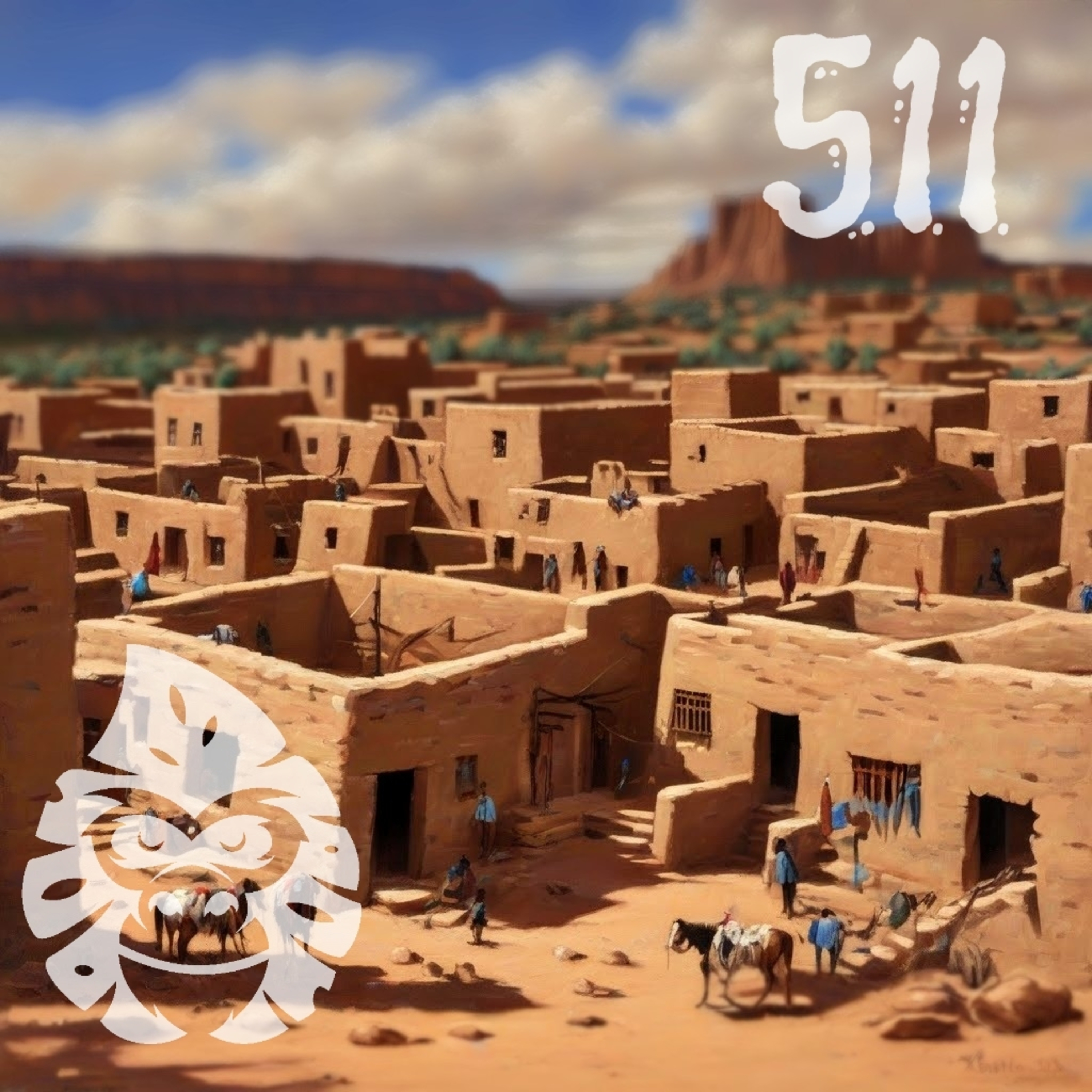
Season 5 · Episode notes
ep. 511 - The Zuni Enigma
This week the guys continue along the ancient civilization path with Rocco covering the book "The Zuni Enigma" by Nancy Yaw Davis. The Zuni of the American Southwest may have less ties with other North American civilizations than they do with Japan. You can contact the show at podcast@primitiveintelligence.com
Images talked about in this show can be viewed at: https://primitiveintelligence.com/ep511
Links:
- The Zuni Enigma: https://www.amazon.com/Zuni-Enigma-American-Possible-Connection/dp/0393322300
- Zuni Pueblo: https://naair.arizona.edu/pueblo-zuni#:~:text=After%20the%20Spanish%20made%20peace,%2C%20and%20Apache%20County%2C%20Arizona.
- Earth Ancients Podcasts with Mahooty: https://www.earthancients.com/?s=Zuni
- Ahayuta (Wikipedia): https://en.m.wikipedia.org/wiki/Ahayuta
- Lemuria (Wikipedia): https://en.m.wikipedia.org/wiki/Lemuria
- Mu (Wikipedia): https://en.m.wikipedia.org/wiki/Mu_(mythical_lost_continent)
Music
Track: "Sub Optic", Birdo
Music provided by https://Slip.stream
Free Download/Stream: https://get.slip.stream/ccdG2w
Listen on Spotify: https://go-stream.link/sp-birdo
Read the transcript
You are listening to the
Primitive Intelligence podcast
episode 511 The Zuni Enigma.
This is the one we've all been
waiting for.
Rocco's got.
I mean, I cleared 500 gigabytes
of hard drive space just to
store all the information I know
you got for this.
I mean, I know you got a lot.
I'm.
I'm glad unfortunately you
didn't clear enough so.
We're going to have to get some,
some some more, some more hard
drives to this.
Well, we'll we'll muddle through
I think.
So hopefully.
This has been a weekly challenge
for me to get the video and the
audio right and last week I know
that my video was all off.
So if you're if you're watching
this and you're not just
listening to it, my audio sync
was all sorts of off.
There was a crash on the server
that we use and it took like an
extra day to get the video file
and it just wasn't right.
So I did the best with it I
could, but hopefully if if that
happens again, I might just do
like the album artwork cover for
the that video and not deal with
all the video hassle.
So we'll we'll see how it goes.
But yeah, so you've been
researching this one for a
little bit.
Yeah, this one, it's I I can't
necessarily.
I said this before, I can't
remember.
Where I heard this or how I
found it, my late father he
liked Native Americans and he
had some things and maybe it was
from there, I can't remember.
But I I it's it's an actual nice
hardcover book believe it or
not.
I picked up I I've been trying
to to go back in time a little
bit with.
More tactile sensations like
actually real reading material
and and trying to stay away from
computers.
So I work.
I work in front of computers all
day.
So I'm trying to to do something
different which is which is
where this book came in And and
it it, it ties into our our last
episode where you had been
contemplating let's say what
happens to societies.
How could they just disappear.
How could we have you know how
could.
Humans have built such such
structures or or roads or
whatever it might be.
And and where did they go?
Well, that's what we're going to
find.
It it ties into that.
So.
So it's going to be, it's going
to be an interesting little
story, all right.
I'm excited, and it's going to
be it's going to be mostly your
show here, so we're going to
just let you run free with it,
the Primitive Intelligence
podcast starts.
All right.
Well, I'm, I'm curious to hear
what you got after all this
research, so I'm just going to
hand it over to you and let you
go.
Yeah, so First off I'll say I I
I felt like a kid again,
actually sitting down reading
and and with a highlighter and
and taking notes.
Everything, everything has been
digital for me for for for a
long time.
So the first thing I will say,
you know this touches on a
couple of different things.
So it does speak about Native
Americans and the book sometimes
will refer to them as Indians.
I don't want to offend anybody.
I'm trying to stick to the the
actual verbiage in the book and
it does touch on some some
thoughts that you know, maybe
maybe Columbus wasn't the first
person.
To to discover America and I
don't want to offend anybody
there, so yeah, so, so mostly
I'm going to stick with the the
book contents itself.
I did do a little bit of
research and a little bit of
Googling, but I wanted us to
stick with the the the actual
content and I don't know if if
in case anybody.
I don't know if this is going to
translate the Zuni Enigma.
It's by Nancy Yad Davis and a
little bit about her.
She was born in 1936 and she's
still alive, living in Alaska.
And she right and she was a
professor at a few universities.
And when it comes to this book,
she started her theoretical
journey March 1960.
And it evolved over time and
eventually she presented her her
theory in May of 1988.
So it's it's it's interesting.
So it's it's not a it's not like
some today.
Sometimes it feels like people
hammer out books and very
quickly so she had some time.
Where I'll start is who are the
Zuni?
It's a good place to start, and
there are Native American Pueblo
people.
Who are believed to be in the
northern New Mexico region for
about 3000 to 4000 years.
So this one is a recent maybe in
in what we think of as America.
But they've been around for a
while.
The the Zuni tribal name, and I
apologize for butchering any
names, is Ashiwi.
So the Zuni name itself some
some claim.
That it was a Spanish adaptation
for a word of unknown meaning.
So who knows where it came from?
And there are others say that
it's a a derivation of another
Pueblo tribe.
The carries if I if I pronounce
that correctly.
So, so realistically if you're
going to search for anything,
you can't search for Zuni but
Ashiwi and it it's it's a
apostrophe SHIWI and I don't
know if I'm pronouncing that
correctly, but I've been saying.
Ashiwi so so this the the the
Zuni tribe, I'll refer to it as
a Zuni tribe.
There are, it's a Pueblo tribe
and there are 19 Pueblo tribes
in North America and that's
that's good for context.
So keep that in mind. 19 tribes.
And as far as the information I
have, Zuni is the largest tribe
of over 10,000 people so.
It it's the the story or the the
interest, I guess where I'll
start is that we're, you know,
why are we talking about the
Zuni, what's what's the deal?
So the Zuni are distinct.
And the fact that they've
managed to remain quite
unaffected by other influences,
they still claim the same land
that they've always lived on,
which is the size of Rhode
Island and that does that is
saying a lot if they're still in
the same land.
And they also mainly reside in
one city which is in Zuni, NM
the interest, and I think this
is sort of how I found an
interest in them.
Is the language itself is
distinct and not related to any
other language.
It does not have any affiliation
to any other language in North
America.
And if you think about the other
19 Pueblo tribes then you would
have to imagine how could it be
so unique and distinct as a
culture.
So that's that's where the.
That's that's where the story
starts.
So you know what, what's the
deal with the Zuni?
What's their story?
And is there any evidence that
we have or anything that we can
find as far as why they might be
unique or what's what's really
their story?
And again, I I wanted to stay
true to the book, so I didn't
actually look up the Zuni story
itself to hear it from their
words.
I was I might be a good take
away, but I'm going to
consolidate what I have from
this book as far as where they
believe they came from and their
journey itself as as a people.
Now it's interesting because I
listened to that interview today
with that Zuni elder, so I'm
curious to see if what you say
matches up with what he said.
I'm very curious too.
And again, this book is not a
new book.
I believe this copy is from the
year 2000 and again the research
started in 1960 and this kind of
came out in 19 where the theory
came out in 1988.
So I'm sure a lot has changed or
a lot of theories may may have
been influenced in the last few
decades.
So the story itself.
I'm I'm consolidating it.
But I'm going to try to hit the
the high marks.
So the the people themselves
they they believe that they were
not created.
They were born from mother
Earth.
So there was the Son Father and
the Mother Earth and in the
beginning the earth was soft.
There were no humans in the
world, and the Son Father used
to travel across the earth and
heard the cries of his children
deep within the earth.
And at one point the son father
saw two columns of foam near a
waterfall and gave them life.
So basically created twin gods
and then ordered the twin gods
to go into the earth and to go
into mother earth and and free
the people.
So that that I think, is an
interesting context where they
were born.
And then were led by the twin
gods on their journey.
To a certain extent do these
twin gods.
Have names.
I don't have the names.
There are two.
There are names.
Yes, I I was out.
There's a lot of names that I'd
probably butcher.
So I'm.
I stayed away from them.
The story and I'm a big fan of
stories.
So when the Earth was young,
they believed that there were
many earthquakes.
And many and frequently.
And they became Wanderers.
So they were looking for a
stable and and well non
dangerous place to to live.
So led by the twin gods they
sought what they called the
middle of the world under the
pathway of the sun.
So they just continued to to
move east along their journey
and the story itself.
Says that they stopped many
times, but earthquakes would
always cause them to leave and
move forward, and it's at this
time that I'd also like to
introduce the Japanese.
So in the Japanese.
There is a speech attributed to
the first emperor of Japan and a
document from 697 AD and and
this is, this is interesting
because we don't have a lot of
well, at least we're not taught
a lot of stories about any other
cultures that knew about
America.
You know, except for the
standard Christopher Columbus,
there's not a lot of thoughts,
so.
This part of the speech from 697
AD, and I'm going to quote this
from the book.
It's now I've heard from the
ancient of the Sea that in the
east there's a fair land circled
on all sides by Blue Mountains.
I think this land is will
undoubtedly be suitable for the
extension of the heavenly task,
so that all so that it's a glory
should fill the universe.
It is doubtless the center of
the world.
So and that was from Japan in
692 this?
Is 697 and this is from.
This is supposedly from the
first emperor of Japan and
there's discussions that at this
point there were Buddhist monks
that were basically traveling
the world and or I shouldn't say
the world, but.
What they knew as the world and
they're trying to settle and and
and find other locations.
And as I think you discussed in
the last episode with the Olmecs
and the Chinese, you know, there
was evidence that it sounds as
though there were Chinese that
that, you know, visited the
Olmecs to the point where
someone was recognized as one of
their their own kind.
So I think this is also an
interesting, an interesting note
that there is evidence that at
least there was this thought
process, a land beyond what they
knew and they believed that this
would be a part of, you know,
what their world is that that
would be important to them.
Also, one thing to know is that
if you think about the ocean.
And ocean cultures there are,
there are a lot of, well, I
should say a lot because I don't
really know in context, but
there were seashells that have
been found, that have been found
in archaeological sites in the
southwest dating from 600 AD.
So there had to be at least a
trade route or some sort of
travel from the Pacific into the
Southwest bringing seashells.
So there had to at least be a
connection.
Out that far now to get back to
the the the story.
So the Zuni tribe has this,
this, this tales in their tribe
that they continue to move on
because of all these
earthquakes.
Because of all this, the
problems in the environment and
we touch on some.
Some dates and and things that
happened in Japan or at least in
that region.
So the period of seven, 732 to
741 was a decade of disasters,
storms, earthquakes, floods,
droughts were widespread.
Famine and plague follow 600
years and the next 600 years
between 1340 and 1350.
There were a number of
calamities that struck.
There was civil war.
There was a drought in 1340 and
earthquake in 401341, smallpox
in 1342, earthquakes in
13461347, a drought in 1348, a
typhoon, floods and another
earthquake in 1349.
And there were so many disasters
that in 1349 there was a custom
for praying from the leaf of.
Of these, of all of these
calamities.
So this is in Japan.
According to According to the
book that this is a reference to
Japan, I did not research to see
if it necessarily was there.
We were according to this, yes.
Oh, this is a reference in Zuni
culture to these disasters in
Japan.
This is a a connection that that
Nancy R Davis makes to say hey.
You know, even though the Zumi
have these stories in Japan, all
of this happened.
And it all happened from like
7730 to let's just say up to
like 1350.
There was all of this, all of
these problems that were being
that the the peoples were
experiencing.
So to get back to the Zumi so
their story talks about.
And and this is, this is what
ties back to your your your
thought process in the last
episode about what happens to
people you know, where do they
go, where do they come from?
Well, this story tells about a
number of people that the Zuni
met on their travels to find the
middle.
You know there was a story about
how they met a people who taught
them much about war.
You know, they they thought they
reached the the middle and they
built homes.
Learned about war.
There were many, but again many
earthquakes.
They died.
People died in their houses.
They move forward.
They stopped.
Again they met another people,
people of the sea.
So they they found themselves in
what they called the steam mist
mists, the waters which they
think is possibly Hot Springs.
So they again they they found
peoples living in houses
scattered over the hills.
They won them over.
And they they integrated and the
children became one.
But again more calamities.
So this one was interesting is
that there was a a story about
how eventual earthquakes, black
smoke, fumes, fire and Thunder
were encountered and there is a
thought process that this goes
back to.
What could possibly be an
eruption in Flagstaff, AZ in the
year 1064?
So there is, there is, you could
draw a line to some of these
disasters that may have
occurred.
So then of course, after this
they move, they move on.
And then they found another
people's who built high in the
cliffs in their own fields.
A lot of possessions and had
knowledge of irrigation, so they
settled there and and that might
tie into the Anasazi, yeah, So I
was thinking so.
There's all these stories and
and eventually they came to a
point where these groups split
into three.
There were people that moved N
people moved South, and then
people that continued to move
east, so.
I I I quickly go over their
story because it is very
interesting.
I will butcher the names and the
locations and the thought
process about the certain
locations that are are unique
and important to them.
But I like the story that they
at least continue to travel east
and they repeatedly met people
they either were.
I'm assuming it's somewhere at
war, but they learned.
From each peoples they settled,
they got knowledge, they
integrated, and then they
continue to move on.
So that ties back for me into
our thought process from last
from the last episode.
Where do some of these people
go?
And like this is it's possible
that things may have occurred in
the past, either they integrated
or there were natural disasters
and people just moved on.
So it's an interesting thought
process as far as.
From where they started to where
they currently are in Zuni, NM,
where they they were on this
this adventure, or seeking,
seeking the middle, seeking the
promised land, if you will.
So the the question then becomes
if we're thinking that or let's
just say in the book, if there
were a group of Japanese monks
that landed on the East Coast,
started to travel into America
and then eventually met up with
the Zuni and integrated, where's
the evidence?
What do we have?
And I, I and I say this a lot as
far as what we know science or
what we know, it's it's just all
about what we know.
So what are the what, what's the
evidence.
So the one thing as I mentioned
in the beginning, the language.
So it's it's very unique to the
Zuni itself.
So both languages and again, I'm
not a linguist so I couldn't
tell you, but the the
resemblances are not only
limited to certain vocabulary
words, but to the synthetic
structures and grammatical
elements, OK.
And it's in between what it is,
what Zuni and what Zuni and the
Japanese.
OK, so the most interesting part
is that both languages exhibit a
preference for using subject,
object, verb order, which is
relatively rare among all of the
world's languages.
And thinking about well, you
have even if you think about the
the the tribes that exist.
Now if if the culture all grew
up in a similar region, you
would assume that there should
be some similarities and and
that could be an explanation of
why their language is so unique.
There are a few words that I'll
mention.
There is a list of words whether
or not they are derivatives of
themselves.
I'm not one to say, but there's
a Zuni word for clan, which is
Kwe Kui.
In Japanese it's Kwai Kwai.
The word for clown is NEWE Niwi
if you will.
For clown, yeah, they had clowns
and well, I can't say what the
definition of clown was, but the
clown and and in Japanese it was
Niwaka, NIWAKA and.
It's just similar.
Similar in Zumi Priest is
Shawani SHAWANI.
In Japanese, it's Shiwani Shi.
Oh, I think I might have that
backwards.
That just verifies how close.
In Japanese it's shiwani and in
Zuni it's Shiwani SHIWANI.
That's close.
So I might have had those
backwards, right?
So there there are some similar
words and there it they do go
into more context about the OR
the not originations with
similarities.
Some of the words to me, I
wouldn't know the difference.
It it, I would say no, they're
not related, but I'm I wouldn't,
I wouldn't be one to know.
You can also look at how they
were pronounced too because just
because we read it the way would
be American doesn't mean that
that's you know their
pronunciation for letter
combinations may be completely
different So it may look like a
different word but it may be
pronounced the same or similar
And and I would, I would
actually like to well I would
like to hear from someone from
the Zuni tribe to see if if if
we had let's say an example of
how someone from China went to
the Olmecs and they could read
or things look familiar.
It'd be interesting to see there
is a reference in here from a
soldier from I believe it was
World War 2 was very was able to
learn the Japanese language
easily and it it seems easier
than normal.
Again that could be coincidence
but it it's it's an interesting
it's an interesting tie so other
similarities and again we're
we're we're drawing a wide bow
here but it's interesting So
other similarities that are
brought up is the their
appearance itself as we
discussed with you know the
Olmecs and the Chinese the there
have been well according to the
book there are people who have
travelled abroad who say the
Zuni resemble the Japanese
especially those from Kyoto or
relocated Tibetans.
So that that's that's
interesting.
The the height of the people, at
least according to the book, at
least two early studies of the
Zuni of Zuni remains revealed
distinctive changes in the
skeletal measurements suggesting
new additions to the gene pool
about the 13th century.
So about that 1350 where there
were so many disasters, it it
possibly there was an
introduction of a new people.
They also mentioned that the
Japanese skulls and skeletons
have characteristics,
characteristics consistence with
those changes, the broader and
smaller crania and a shorter
statue stature.
Sorry.
So again, without any genetic
evidence, we're making an
assumption here.
The Zuni people for some reason
their skeletons changed.
Why?
We don't know and we can't say.
All we could do is guess the one
thing that I found was
interesting in this that I would
have never thought of before.
I would have never even
approached the topic.
But they discussed teeth, and
apparently teeth have
characteristics.
I had no idea why not.
But according to this, one study
found that the Zuni dental
features, even though they're
distinctive in some ways,
closely fit more to A to
California Native Americans then
with their neighbors in the
Southwest.
And there are also studies that
have shown three modern dental
features that are clearly
separate from other Native
Americans and might be explained
with a mixture with the
Japanese.
So again, characteristics within
the teeth that are different
from other Native Americans.
So it's it's another tie and and
here's an interesting one what
what is referred to as the Zuni
disease and I know if you really
want to hear me butcher
something it.
Can't be worse than anything
I've done now, Mes
mesengiopathic
glomerulonephritis all about
that.
So if you pronounce it right or
not, I don't want it, no.
But what they were calling the
Zuni disease, the Zuni disease,
it's referred to, and they have
a high, an exceptionally high
incidence of this disease which
causes chronic renal failure,
ultimate leading to end stage
renal disease and death.
So it's higher than there.
There were some statistics, but
these statistics could be
decades old so I didn't actually
jot them down.
But the disease itself is also
reported to be common in some
oriental populations, per the
book and best described in Japan
and Singapore.
So it's interesting that there
is this disease that is not
unique, but it but is is
characteristic of the Zuni that
also has ties to possibly
Japanese ancestry.
I might have found a easier way
of pronouncing that chronic
kidney disease.
Who nailed it?
Man, you're pretty.
Good.
I'm looking it up and this is a
CKD chronic kidney disease.
But I I did find that
interesting if I I'm more
scientific where I'm trying to
tie things to something
substantial and and this is
where I'm going to, you know.
Again in her book she says you
know, time will tell, she might
be wrong, but it it it, it
requires further further
research and she mentions that
one of her ideas for this came
from when she was looking at the
Yin Yang symbol.
And again Yin Yang.
You think Chinese but she found
resemblances to a Zumi chart on
Zumi religion.
Now I was searching for the
chart or something to tie it
together.
I didn't necessarily find it,
but if that's what started her
on her journey, I applaud her.
If there was some sort of, you
know, interest there.
There was also resemblances to a
chrysanthemum which is one of
their which is important in
their religion and the Rosetta
from from Japan.
And I've I've shared an image
with you that you can you can
put in the notes.
Again, it looks similar, but
it's a flower.
So again you could draw a bow
there that there are some
connections or it could just be
a flower.
And the last thing I would I
would find that's interesting is
the and and I don't know how
true this is.
I was trying to find it, but
according to the book there is a
petroglyph that that was found,
you know in in the region and
it's basically a box with a plus
sign in the middle of it.
So just just a box with a cross.
And this is no it's a it's a
petroglyph that was found in the
region and the the tie there is
the Zuni word.
I'll butcher this Taiya TA.
Apostrophe IYA means a place of
planting.
So in Japanese TA is a rice
field and in Zuni IYA or LLIYA
refers to a place.
So although this this little
symbol which is a square and
plus sign in Japanese, that is a
symbol for a rice field and the
Zuni word is quite possibly TA
meaning rice and the place you
plant rice even though they
didn't have rice, it would have
been more or less corn.
But the theory goes is that it's
possible that the word for a
place of planting might really
have originated for a rice
field.
At least that's the that's
what's interesting to me that
that's that's that's the the and
and again that that's, that's
what I would have was really
hoping to find an actual picture
of this petroglyph to see if I
could find it.
Yeah, I'm looking now.
I couldn't find it.
And to me it's very interesting
that, like, if you're talking
about a place of planting,
there's also a discovery that
could be a symbol for a rice
field and the place for planting
could be literally the breakdown
of the Japanese word for rice
and a place for planting.
So it's it's it's an interesting
discussion.
Unfortunately, there's not a lot
of evidence and there's also
discussion about well, if you
know, if the Zumi people wanted,
you know, at this point, you
know, back when these these
thoughts were were these
theories were being, you know,
created or or or or thought
about, there really wasn't a lot
of genetic testing.
But today there quite possibly
be some genetic testing to see
if there is any kind of Japanese
heritage.
But for me, the thought of the
story of whether it's Buddhist
monks or whoever it might have
been who left the region,
traveled across the Pacific,
landed possibly on the shores of
California, and then made their
way into the desert, or what we
know today is the desert met
people or maybe they settled.
Maybe these could have been one
of the groups of people that
settled.
Maybe they were the planters.
You know, maybe they were the
people who planted the seed or
they were growing.
And then, you know, whether it
was calamity or something made
them move forward.
Eventually they just adapted
each other's cultures until they
settled where they are today.
That's so this isn't saying that
the the Zuni are Japanese, but
there was a heavy Japanese
influence and maybe integration.
It's it's, it's more or less the
theory that there was
integration and if so that would
explain the the changes to the
name or the, I'm sorry, not the
name the the language.
So it could have been had the
influence as to why the language
is so unique and you know also
to let's say some of the genetic
changes that that occurred or
they believed to have occurred
since like say 1350.
There were also references in
the book to pottery and possibly
you know, glaze pottery and
smelting and things like that.
But again, I personally believe
that humans are very smart, all
humans are very smart and I
think eventually people will
discover technology.
So I can't say and I don't
necessarily believe that we have
to 111 culture has to rely on
another culture to come up with
pottery or smelting.
I I think people are very
intelligent, you know, So I I
didn't really include stuff like
that, but I tried to at least
include some things that that
are there's something to think
about.
You know, here's something to
think about.
I just sent you an image of the
flag of Zuni, New Mexico.
I'll put that in the show notes.
That's very interesting.
Square flag with a circle with a
plus sign in the middle.
So.
So I just sent you a screenshot
of an excerpt from the book that
shows what you know of.
Of course, this is from a
typographical image, but it's
just a square with a plus, so
that's interesting.
Did you the?
Was that text or did you e-mail?
Oh, there's.
I got it.
There's Oh, yeah.
Oh, so it's like the full
square.
It's a full square but but but
we're talking about this is from
a book not a drawing so when I
was looking online there could
be different style you know
stylizations but but it's still
it's it's that's interesting the
the the the Chrysanthemum and
the Rosetta.
The the Rosetta is very
important and I I'm not going I
don't have my notes these notes
in front of me but I know at one
point I think it was in World
War 2 the the rifles were
stamped with the Rosetta and at
at the end of the war when the
one of the terms is like you
know what when World War 2 is
when there was the admission of
defeat.
One of the requests is that
before we turn our guns and we
have to grind off the Rosetta
from the guns because that was
because it's just, it's such an
important aspect of the Japanese
culture.
And and again there is this
Chrysanthemum is I believe what
they were calling it, which is a
flower and a design which very
closely represents the Rosetta.
But again, it you know, I think
all cultures, if you're going to
draw a flower, you could, you
know, you might be able to get
to the same drawing or similar
drawing.
Yeah, I as soon as I saw that
symbol with this square and a
cross it, it made me think of
like a rune more than like a
Japanese symbol, like a not like
a Nordic symbol or a rune.
I couldn't find anything and and
if that was just a petroglyph by
itself to me, again you could
read into a certain you could
read into a lot of this.
But the fact that the word for
rice in Japanese is TA and in
Zuni let's say iya is a place.
So you have a place for rice or
a place for planting it's.
It's so similar that it's it's
really intriguing to me, like
it's just to me, there's a a lot
of similarities here.
Or I would, and if this isn't
the answer, I would be really
interested to find out how you
know how these people's language
changed from what it was to what
it is, if everyone around them
had a common way of speaking.
You know, how did the structure
change?
Yeah, usually there's.
It may not be identical, but
there would be some bleed
through from culture to culture,
that neighbor, right?
You know, that doesn't seem like
that's the case here.
So so that's that's the the
story.
And unfortunately I have no
evidence.
I have, I have nothing.
But for me, it's the story.
It's.
The best story I ever have.
Evidence and and I love I love
the idea of of a group of people
travelling across the Pacific in
a boat and who knows when it
could have been you know 1000 AD
whenever it was who reaches the
shore and then just continues to
travel until they meet another
people and then just become one
tribe and and just integrate in
in a world today where there's
so many differences and people
are focused on differences they
found a a commonality and and
continued and that's that's
that's what I want to think.
Did the the author say where she
got these all this information
from just through her own
research?
Or did she speak to anybody
there are?
I mean, you really would need to
look into the book.
There are a lot of references to
a lot of other studies.
And so they're they're she does
tie on to her, tie back to a lot
of other studies that were done.
It wasn't.
It was her idea and she tried to
find commonalities, but she does
tie things back to other studies
that were done.
OK.
The reason why I'm asking is so
knowing what you were going to
talk about today, I I sat down
and was working today and put on
a podcast.
From 2020, I don't remember the
name of the podcast.
I'll I'll put the link in there.
It was like our ancient earth or
something like that was the name
of the the podcast and he sat
down and did an interview with
Clifford Mahuti who was a a Zuni
elder and at this point like he
had spoken to this guy a few
times so he they had a a
rapport.
And at this point, this Clifford
Mahuti was basically booted out
of the council because he was
starting to spread information
about the Zuni, the tribes,
their origins and all this
information that the council
didn't think should be given
out.
And he's he's even saying that,
like, at that point.
Now he he passed away in 2022 so
this is just a couple years
before he died this interview
but he said that even in in 2020
the the Zuni, the Pueblo Zuni in
New Mexico only practice about
20% of the like the the rituals
and the celebrations that they
did even 100 years ago.
So like their culture was just.
Not even being forgotten, it was
just not being shared at all.
So when the Spanish came through
and they basically most of the
Zuni converted to Christianity
and it was not, nobody wanted to
talk about their their, their
past.
So one of the things he said was
that a lot of what people know
about the Zuni is all BS.
Because the elders and the, you
know, the the the ones who came
up before who were telling the
how do you, how do you say it?
The wide eyes, the the white
man, the wide eyes, they would
just tell them stories, Whatever
they wanted to hear, whatever
got them out of their face.
They just make up the story and
tell them so a lot of the
information that we have about
their customs and their culture
is all made-up.
The reason why they want him to
step down or that why they they
kind of booted him out is what
he did mention stuff about.
Let's see where do I have it
here And my notes are very all
over the place.
History of the Japanese and
Chinese living with Zuni as
early as the 1200s with Chinese,
and I think with the 15 or 16
hundreds that their first
mention of the Japanese.
There's actually a book.
By one of the one of the Zuni I
think he was Zuni.
His name's John Rushkamp Junior
and it's Chinese symbols in Zuni
petroglyphs.
So it's known like in the guy's
like, what do you mean?
Like I'm gonna have to get that.
Book.
Yeah, me too.
He's like, you mean like like
they look Chinese.
He's like, no, no, it's it's
Chinese Petroglyphs.
Well, it but the.
NPS, the National Park Service
and the government bought all
this land, he said.
When he was a kid it wasn't
uncommon for him to be out in
the in the desert and there just
be people out there with guns
just shooting the petroglyphs
off the rocks just blasting the
faces of the rocks off to just
eliminate the the culture.
So I'll I'll say before you move
forward there is a part of this
book does touch on it but I
wouldn't do with justice about
how the Spanish came in and
eventually there was an uprising
and and that's not that's a
story but it's it's a it's a
story that I wouldn't do with
justice.
So there people would if you're
interested look for that story
which I didn't touch on the, the
other interesting I think is I
didn't mention glazed pottery
and smelting.
Well, one of the items that was
mentioned in the book is that
you know or I shouldn't say
smelting like metalwork is that
yes, this was, you know, this
was prevalent in China at the
time, but there was no
connection to China other than a
reference that hey, the Chinese
were were were practicing this.
And so it was known so that that
knowledge could have been shared
to other cultures in that
region.
And and if, if the Chinese, if
there were Chinese who came over
and were integrating and
interacting with the Olmecs, I
mean that's only, you know well
a couple 100 miles difference
from New Mexico to the Four
Corners region, it's not that
far.
And you know, so and the Olmecs
were in South America, right?
I think there was South America.
Yeah.
So that that's a little bit
further distance but that's
still they they may but there's
also been there's also well I
don't I don't want to say
there's evidence but there's
there's been talk that I've
heard of could be rumors or
could be people trying to to
make something that there's not
that that says there could have
been a trade route.
You know, if like you said, if
somebody's going to to come
across the Pacific, it really
wouldn't be much for people to
go north.
No.
And I, I mean I find it hard to
believe with even what evidence
we, you can kind of find that
there was not trade that that
North America and South America
were just completely unknown.
You know, I mean they were, they
obviously they were seafaring
nations, seafaring civilizations
way earlier than we think.
And I always try to, you know,
when people question that, I
just think.
You know, if if we've been
around for what we think 40,000
years, Homo sapiens, right, 40
to 50,000 years, somewhere on it
we think.
And we're just getting
technological advancements in
the last 200 years.
What?
What were we doing for the 1st
39,000 years?
Yeah, and we couldn't have been
that stupid for that long and
survive and and that's where and
that's where you think about,
you know, as far as what we
know.
So if you think about the
Japanese culture and how they
had this tradition of making
swords where they would bend
metal, that's what we know.
And they were masters to a point
where other people couldn't
necessarily figure out or
duplicate it, but they were.
And and So what else happened
that we have no idea what
happened and where?
Where did the knowledge go?
Or it could have been just as
just simply maybe, maybe there
was something devastating that
happened.
Yeah, I I didn't hear that.
I'm I'm, I'm going to have to
take a look at that book.
I'm gonna have to look that up.
I was trying very hard not to go
away from this necessarily,
'cause it was, it was, it was a
lot to chew on.
And I have to give her credit.
If she was thinking about this
in the 1960s and today, you
can't really say much.
But back then, I mean, I
couldn't imagine if she was
talking to people about this.
They must have.
They must have thought, you
know.
Who knows what they would have
thought.
Or maybe they're more open to it
today.
You can't say.
You can't.
You can't.
You can't change narrative now.
So the reason Mahoodi was really
in trouble with the with the
other elders wasn't stuff about
the Japanese, Like they didn't
really, they don't really want
their secrets known.
But what he was really talking
more about is that the Zuni do
in their in their rituals, so in
their in their memories, because
that's how they continue their
stories, in their rituals.
They do.
There is evidence that points to
knowledge of the great flood.
They also say that we're in
well, probably just ending.
We're probably just beginning
the 5th world at this point.
So we're in the fourth era at at
this time when he did this
interview and this is this is
something that is shared between
the Zuni and the Hopi.
The story that of their what I
heard their the story of the
beginning of man, beginning of
the Zuni from the Hopi.
No, from the Zuni, from his from
the Zuni elder.
That he didn't say anything
about the twin gods, which I
did.
The he, he, he, he, he, you to.
I'm going to say they didn't.
I didn't find any specific
names.
I did find the Ahiyuta.
I didn't find anything about
them or he didn't mention them,
but what he did mention was in
This is going to sound familiar.
Lemuria Pan?
Yeah.
Really.
Yeah.
So what he was talking about was
that Lemuria or Moo.
It's also known as Pan.
It's known as was inhabited by.
Androgynous beings who are not
human.
The island sank and as they knew
it was coming.
So as the island sank they
scattered and they went to the
all the continents, right?
Because Lemuria is supposedly in
like the Indian and Pacific
Ocean like a a huge landmass and
they they some stories actually
say the Easter Island was a part
of it or part of that island
chain.
So a little tie back to last
week.
As the inhabitants fled, though
many of the children were lost,
they drowned.
They they fell to the sea, and
these children became all of the
creatures of the sea, dolphins
and whales and fish, And then by
the time they got to land.
They they basically made it to
what he believes is like the
Yucatan Peninsula and then it
spread from there that the
people from Lemuria even settled
on Mount Shasta and then there
was the somehow, I'm not not
sure how because he it's kind of
kind of scattered his story, but
he also talks about the star
people and how the star people
came to help and created.
Like when you see these
petroglyphs of the long
elongated skull, there's like
people with like long skulls or
very like squat the beings that
those were the either the star
people themselves or enhanced or
hybridized creatures to help
assist from the from lemuria to
land to to like human life.
And then doesn't really say what
happened to him other than no.
But this is not allowed to talk
to me, right?
So this is what Mahoodi
believes, if I'm saying that.
Correctly, right.
Yeah, Mahoodi.
And then the guy did ask.
Oh, he he also mentioned that
after the the Zuni and the other
tribes and the other humans
basically got their.
Sea legs, right?
They they knew what they were
doing.
There was a catastrophe.
And the inner Earth people, also
known as the Ant people, went
back underground and these were
like 2 to 4 foot tall beings.
The shorter ones were kind of
translucent and the taller ones
were kind of reddish.
And this guy's like, what do you
mean by like, what did they look
like?
And he's like take a a close up
picture of a of an Ant he's like
and then compare it to an alien.
He's like that's what you got.
And he's like this isn't
something that's new, like all
these UFO sightings and all
these things that happened, he
goes we already know about this.
He said.
They're they're
interdimensional.
They live within the Earth, but
they're interdimensional and we
just know this and they're
pissed because we're screwing up
the planet and if they come
back, we're in trouble.
Now this was in 2020.
I was just going to say that was
in 2020.
This is just at the beginning of
of the pandemic and he's like,
they're going to come back and
they're, you know, they we have
some communication, but they're
pissed.
And this guy says well-being,
that the Zuni had a, you know,
great understanding of the stars
and the sky.
He's like, is there anything you
can tell me about?
Stonehenge like structures in
the Americas that were built by
the Zuni and he basically said I
can't tell you, I've been
forewarned not to get that
information out and my life has
been threatened.
Somebody doesn't want to.
Talk, somebody doesn't want to
talk.
And now and this guy like I, he
seemed pretty with it like, I
mean he was like 67 at the time.
Well, I mean, I could also,
playing devil's advocate, if
you're like on a council and you
start talking about how we don't
know our traditions and, you
know, there's people and and I
could understand how they might
say, hey, you need to step down.
Yeah, that's that kid.
But there's what?
There's well, the Hopi people.
Don't the Hopi have the same?
Yeah, the Hopi people have the
like the star people and the the
Ant people and they they have
very similar stories, but this
is coming from the Zuni and
they're like, they just don't
they they want basically all
these stories squashed and
probably because.
And from what?
He didn't say this specifically,
but the the gist of it I got is
it hurts their profits.
Like they can make money right
now and this is going to hurt
their profits.
So you got to shut up.
Or they just want to keep their
knowledge.
Maybe.
Maybe they're the chosen people.
Maybe, hey, they're not.
They'll tell her secrets.
They're.
They're not even using it
themselves, apparently, from
what he's saying, like they
don't like if they do a ritual
he's like.
They just, he called.
He was calling it Wham bam,
thank you ma'am Ceremonies.
He's like they come and they say
a couple words they they flash
some stuff and they they're like
they're not even doing the going
through the motions anymore.
Like they don't even want to
perpetuate it.
Interesting there there are
there are images in this book of
of certain I I don't want to say
like I'd I'd say gear like
outfits and things that they
would wear for ceremonies,
ceremonial outfits.
But I didn't really touch on
ceremonies other than from the
book set is that they are
continued.
But again, this book is older,
but what I think is interesting.
Very very limitedly.
And what I what I also, one of
the things I found was
interesting is that let's just
put it in perspective.
If she started having this idea
in the 60s, it came out in the
80s.
There's a book about it.
I've never heard of this.
I've never heard of it.
So what?
You know.
So if this is something that is
actually documented and printed,
if you're talking about stories
and and and just people's
telling tales, who knows what
what what stories were lost or
you know or or what rituals they
used to perform?
Yeah, and and even he says like,
I don't know that he's or that
he was trying to save, you know,
certainly that, you know
there's, you know any of this
stuff is real, but it's it's the
way it's passed down from
through their their stories.
And it could mean anything.
But even at that, they don't
want it.
They don't want it shared,
right?
And the Hopi?
The Hopi I don't.
I have a map here but I don't
have it highlighted.
But the Hopi are in the region,
right?
The Hopi are, yeah, yeah,
they're in Arizona, New Mexico,
Nevada and Utah, I believe,
right.
And and like this story, at
least their story that according
to this is that eventually
people went north-south and
east.
So it could be remnants of the
same cultures, it could be in
those stories, it could be the
you know.
And it it's so like what What's
the what are the words I'm
actually looking for here?
How do you prove or how do you
if those stories are being
eliminated?
Other than if you could do some
kind of DNA testing, of course
they should be similar DNA.
How fine of a test you need to
do to find where the differences
are, you know?
I mean if we can still find
Neanderthal DNA in in current
humans, you know it, would it be
that hard to find?
You know Chinese or Japanese
DNA?
Would it even show up?
Has has it been too long?
Is it?
Is it or not enough?
But you think after thousands,
10s of thousands of years, we
still have Neanderthal DNA.
You know, you think the test
would have been run by now?
I would think so.
If, if.
Well, if, if you're making a
such a stretch that has cultural
implications and especially
today.
You know individuals may have
taken tests.
You know individual, let's say,
say ancestry tests.
But as a as a people's, I don't
think there has at least not
that I'm aware of an actual
study done to do.
Let's just say if you're if
you're thinking about a
statistical, you know portion of
the population to see what is
there and you know and then even
try to connect it to other parts
of Japan or the region.
Well a quick search shows
something someone definitely
confirming the fact that DNA
testing proves that the various
Pueblo peoples are related to
Anasazi.
Now that that was my first
result off of the Internet, so
that could be completely wrong,
but it it would.
It would seem that there should
be some similarities there.
Well and and and like this story
story says that there were they
were traveling before they
settled.
They were traveling and they met
according now this is according
to, according to the book,
according to their their legends
that they met various peoples
and some of those were you know
integrated or they or I I
shouldn't say integrated with
the zoning, but maybe they
merged.
So it happened and it had you
know and and that could explain.
A lot of different things as far
as population moves or you know,
what happened, why some people
left and some people, they
shouldn't even say left.
Maybe they just moved, just
moved.
Well, if they were searching
for, what would they call it?
The middle.
The middle.
So they were searching for a
specific place and they're not
going to be happy until they
find it, or they find what
matches what they think they're
looking for.
And then once they find out that
spot that's that's where they
stop moving.
But until that point, they're
just gonna move around until
they find the spot they like.
And and let's just say that if
if there's all these legends
about all these earthquakes and
natural disasters, then, you
know, I would put faith in it.
Because if you're in a spot
where you're settled and you
have homes and you have crops
and there's water, something's
gonna make you move.
And and and and and.
That would have to be something
pretty serious.
Now, I didn't look into that
volcanic eruption.
That's kind of interesting.
Well, when I was in Arizona a
couple years ago, I mean, we did
hike in an extinct volcano and a
lot of the buttes and mountains
there in the high desert from
Flagstaff N are just the
remnants of volcanoes.
So yeah, I could absolutely see
that being, you know, being the
case.
And and I I also try to always
put it in perspective that.
Let's just say 10,000 years ago,
if if I'm correct on this, that
there were, let's just say I
don't say woolly mammoths, but
rhinos and giraffes.
There were.
Other America didn't look the
same way, and that's 10,000
years ago, which seems like a
lot, but we're talking about a
story from a few thousand years
ago.
So what?
What was it like a few thousand
years ago compared to today?
So it could have been.
A beautiful landscape where
there was a lot of lot of food,
lot of water, lot of animals.
So in order for you to not think
you found your destination, it
would have to be something
pushing.
Yeah?
Now it's interesting that you
mentioned woolly mammoths,
because I did in that same
interview they did talk about
and I got to look into this to
see if it's true.
Or this may not be true at all,
just in in this interview, but
they did talk about where in
Russia.
So this had to be Back in 2020,
maybe 2019, they uncovered
remnants of a settlement from
early human and I.
They didn't say if it was Homo
sapien or if it was Neanderthal
for someone else, but they were
just saying hunter gatherers.
So they'd not.
They're nomadic.
They don't stay in one place,
but they found they they were
finding these small structures
that were made from mammoth
bones, but then they found this
one that was made from the bones
of 60 mammoths, now mammoths.
Are huge and they said this
thing was was massive in scale
and they they don't.
It's similar to like mine
culture where they would build
these giant structures for these
like feasting rituals and it was
similar they said, But I didn't
look into it.
I mean I just heard it in
passing in that interview, but
it it I kind of wrote it down
like I got to look into this.
But if they were hunting
mammoths and then taking their
bones and building some kind of
structure out of 60 mammoths,
like how big?
I didn't see the picture, but
how big does this structure have
to be?
And it's another instance of a
culture that supposedly didn't
do these things.
But now we're finding that, oh,
well, they did.
They did do these things.
Yeah.
Yeah.
So that's because it's all what
we think we know.
Right.
It's all, oh, they couldn't have
done that because we don't have
a picture of it.
Or Oh well, today that wouldn't
even mean anything.
That wouldn't even mean that
this was in like, I think this
is in like Siberia.
So it was, it was kind of
preserved in the ice.
But imagine if they did
something like that in the
South, in the southwest, but
they were using wood or stone
and it's been destroyed.
Yeah, I'd be destroyed.
Yeah, Well, if you look at the
the Choco, is it the Choco
Cavern?
I should know this.
That's where the Anasazi is.
Oh, it's just the the the huge
cavern that has its own clouds
and there's like massive
structures.
There there is A and I I believe
it's a National Park, but it's a
Chaco cavern.
If you look at some of the
structures out there, they're
just what you What you find now
are is impressive.
And if you think about a people
that were building, let's just
say they were building out of
using mud and dirt mortar, then
what would be left?
I mean, the Cliff, the Cliff
dwellings are there, yeah.
But you don't.
There's not a lot of erosion.
I mean, they're slowly going
away slowly, yeah.
And I was in some in Walnut
Canyon, some of the the the
Pueblo Cliff dwellings in
Arizona and that's the Walnut
Canyon National Monument where
you can hike down at the Canyon,
You come around a corner.
There's all these structures
that were built in the cliffs
and they were really cool and
fairly well preserved to the
part point where there's still
some of the original timber left
too.
That was really, really cool to
see.
There's also, I want to say I I
can't remember where I saw it.
I want to say it was in England.
There, there, there's been some,
there's a YouTube channel and
I'll have to find it.
You can put it in the notes.
Where there are some some folks
out there who are still going
around and looking at some of
these older sites and and a lot
of the henges that you might
find from wood a woodhenge.
So you don't really find
anything other than you come
across a hole.
And the only reason you know
it's a hole is because there's
different dirt in it.
Like the dirt looks different,
But you would never, you would
never even know it was there if
you couldn't find these spots
where it looks like they had
posts and some of them are
massive, like they've built
cities on top of some of them.
And it's like whole
neighborhoods were once these
these Stonehenge or these
Woodhenges, and you can kind of
see where the outlines are,
'cause they're still like maybe
there's like a stone structure
in the center and that's still
there like a park.
And then if they do sound
penetrating your radar, they can
see where the the soil, the
ground is different underneath
it and they're massive, these
structures.
Yeah and and so so you think
about and that's and that's what
we would we talk about now and
and you think about how long ago
a a a Woodhenge would have been.
So even if you're talking 1000
years ago or 2000 years ago,
it's the same time, it's just a
different people in a different
location.
So there could have been
different structures and we
would never know because now in
the Southwest it's more desert
like.
So who knows what would have
happened like that?
You know that erosion could have
just taken it away, where in all
the like like Siberia, ice or
snow could have covered it.
And and in these other climates,
dirt just covers it.
Well, think about how many times
we're out on our travels and we
see an old house like we like.
It's been nine years.
Every year we've gone up to the
same two parks in the fall.
Like, I I pulled up the photos
every year, right?
And there's we came back a
different way this year than we
have in a few years.
And there's a couple old
buildings that are just almost
gone that were standing two
years ago.
That's that's a that's a modern
house that's just gone thousands
of years later.
There's not going to be much
left unless it's stone.
But even that's going to erode
and get buried, and you have to
know where to look.
And.
And how would you know?
Except for stories, yeah.
Yeah.
And and if you right that's
that's the only way you're gonna
know.
So it's it's it to me, it's just
it's fascinating to think that
people still believe a narrative
exclusively based on just what
we know.
Well, this has to be it, because
that's what we know.
It's like, well, you don't
really know.
Like if you look at Stonehenge,
well, they the the stones came
from a different spot.
And if they've identified that,
OK, you know that, but you have
no idea how they they got them
there or when they moved them or
really what when it was when or
why just don't they're so right.
Why?
You don't know.
Yeah.
I mean, this guy was saying
this.
Mahuti was saying that he he
says you think he goes, you
think the Egyptians built those
pyramids.
He goes, no they were there when
they got there.
Like this guy was all over the
like he had information about
everything and I was like, it's
it was really cool.
I'll send you a link to it.
I'll pull the the podcast and
I'll send you a link to it.
It was it was really cool.
But it's just it goes to show
that we don't know and we only
know really what we're allowed
to know or what the narrative
says we're supposed to know.
And if you go against that then
you get shot down.
You get called a nut job.
You don't get funding for your
research and if we're, I mean it
doesn't just happen here it
happens all over the place
anywhere where there was you
know indigenous people and now
you know it's it happens
everywhere that if you try to
change that that narrative now
and you're taking away you know
rights or beliefs or a culture
whether you're trying to help or
not.
It's you get shut down if it's
not the the narrative that
either that culture wants you to
believe or the culture that's
taking it over wants you to
believe.
Whoever's got the stronger pull
in that situation, if if you're
trying to tell, even if it's the
truth, something different,
you're going to get shut down.
History is written by the
victors, right?
Well, anymore by the, by the
richest.
Or the bullet that's usually
usually evident.
Whoever's got the most go.
Right.
So it was interesting.
It was an interesting story.
I'm glad I finally read it.
I've I've.
Had this.
I've had the book for a little
bit now, a couple of years, and
I pick it up and I put it down.
So I'm glad.
I actually I actually read
through it now.
I guess start your next book.
I have another couple of things
here.
Cool, but a book An actual.
An actual.
Big book I don't know about.
Yeah, take some time and do
something fun.
Yeah, it's it's fun though.
I mean, it's it's, I I like
doing the research, 'cause
that's how you learn.
And it it keeps me off of TV.
It keeps me from doing dumb
stuff.
And you know, even if what I,
even if what I learn winds up
changing later because new
information comes, it's worth it
because that's that's how you
learn.
You know you can only learn what
you have put in front of you and
then make your own decisions.
Yeah, I agree.
I mean, I, I well, again, we're
different, 'cause I just like
this story.
Yeah, well, I mean, I like the
information too, but I'm a big
fan of bunch of people got in a
boat.
How many people?
I don't know, 20.
How many people are gonna fit in
a boat?
Yeah, you figured in in 1000 AD,
How big were the boats?
I don't know.
So boats left, flew, came across
the Pacific and then decided to
travel through the desert.
I think that's a really
interesting story.
The boats could have been big.
We don't know.
Could have been no.
You know, they just because they
were made out of wood doesn't
mean they weren't big.
Again, what do we not know?
There's a lot we don't know.
There's a lot we don't know, but
that's all we know for this
episode.
Yeah, we've been talking a
while.
That's true.
You.
You didn't think you're going to
be able to fill an episode with
that?
That was.
Yeah, was good.
Parts of it were very academic
and hey, we got a smart
audience, so that's I'm not
worried about.
That well, just, you know, I
don't want this to sound wrong
but it was it was academic and
some of it felt dry and.
You know, reading about the
formations of teeth never wasn't
planning on that.
So some of it was, you know, a
little bit of a push or easy if
you just kind of glanced at it.
Yeah, but yeah, but it was a
good story.
It was a good story.
And that's that's what it's all
about.
Well, that's all.
I don't.
I didn't really do much this
episode.
I just listened to a an
interview with a elder and then
listened to you talk.
So I got nothing left.
I got nothing much either 'cause
I'm done talking, all right, so
I'll put the links to some like
I got the link to the book.
I'll put that in there.
So if anybody's interested in in
looking at it, I don't know if
it's a hard copy only it may be,
But and then I found some links
to as you were talking, I was
trying to pull links on some
stuff.
So I'll throw some links down
the bottom and you can do your
own research if you want to
learn more about the Zuni and
thank you for listening.
If you guys want to get in
contact with us, it is podcast
at primitiveintelligence.com.
Oh, there's Instagram.
I do have Instagram.
I'm throwing up some taking some
clips of the podcasts and doing
some digital art and then
overlaying the digital art with
the clips and then put them up
just to like little short
things.
But.
So put a picture of the original
monkey in there.
Oh yeah, he did send me that
picture.
Is he in your shop there or in
your In your?
He's in the office.
Yeah.
Yeah, he should.
Yeah, I wouldn't be able to show
it to you on video because I'd
have to turn this thing around.
You should put a little shelf
behind you and put him up there.
I'll come back, yeah, come back
there.
Stare at me?
Yeah, yeah, I'll put a picture
of him in the show notes too.
So that's going to do it for
this week.
See ya.
See you later.
The.
No matching lines.