Season 5 · Episode notes
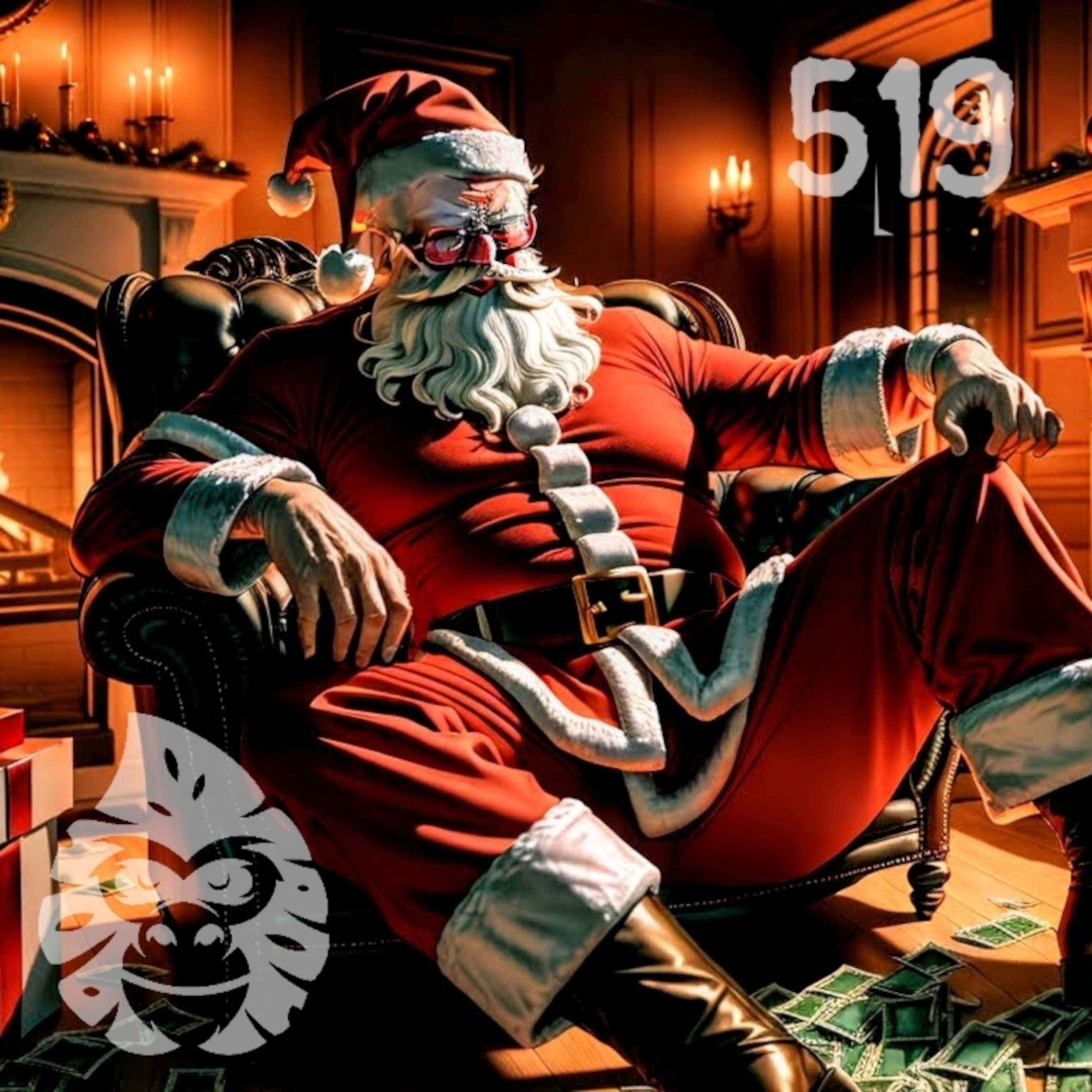
ep. 519 - How Santa Claus Stole Christmas
Have you ever wondered how someone from the North Pole, who dresses in a red suit, has elves working for him, drives a sleigh powered by flying reindeer and can visit every home on the planet in 24 hours wound up being one of the most recognizable figures of Christmas? Me too.
As always you can contact the show at: podcast@primitiveintelligence.com
Links:
- https://www.livescience.com/42976-when-was-jesus-born.html
- https://apnews.com/article/saint-nicholas-day-santa-claus-fe4aa5607763558f48171b44036b806d
- https://www.smithsonianmag.com/history/civil-war-cartoonist-created-modern-image-santa-claus-union-propaganda-180971074/
- https://www.britannica.com/topic/Santa-Claus
- https://www.byerschoice.com/christmas-traditions/krampus
Music:
Track: "Rest Yall"
Música proporcionada por https://Slip.stream
Descarga gratuita/transmisión: https://get.slip.stream/EIskQ6
Read the transcript
You are listening to the
Primitive Intelligence Podcast
episode 519, How Santa Claus
Stole Christmas, Not the Grinch,
Santa Claus.
If you're listening to this or
you clicked on it on YouTube and
you're thinking this is a good
one to watch or listen to with
your kid, don't.
That is your warning.
That is the disclaimer.
If you listen to this further
and your kids wind up sad
because of what I'd say in this
episode, it is your fault.
You've been warned.
Now moving on, I've always
wondered how Santa Claus became
associated with Christmas.
Like I've heard stories and you
know, you kind of piece things
together, but I really wanted to
look into it.
I was going to do this as a
little bit more of a like a goof
funny kind of episode, but
there's actually a lot of
history here.
So the very beginning of it, I
kind of researched it a little
more on the on the the lighter
side, so there's a little bit of
goofier information, but then it
gets into the actual story and
we're going to piece some things
together.
This very special Christmas
episode of the Primitive
Intelligence Podcast starts now.
Chances are regardless of where
you are, how you're raised, what
you believe you've heard of
Santa Claus in some shape or
form.
But how does this jolly red
suited fat man with a beard who
sneaks down chimneys?
How does he fit in with the
birth of Jesus?
Have you ever wondered this?
How do these two things?
It's like Easter.
Like, how does Easter in a
rabbit that lays eggs and
carries a basket?
How do these things fit
together?
Well, let's let's have a look,
shall we?
First, let's just go over the
stats of Santa Claus, and this
is the the kind of goofy part I
was just mentioning, but we'll
go over it anyway.
Well, reportedly lives at the
North Pole, which in and of
itself is a pretty good feat
because North Pole's got no real
infrastructure up there, so
keeping things running pretty
good.
So living up North Pole employs
elves and reindeer who may be
either magical or are enhanced
with some kind of technology.
And with the use of this magic
or advanced tech, he can travel
around the world, visiting every
residence on the planet in 24
hours.
Estimates are that there are 2.3
billion homes on Earth right
now, meaning that he'd had to
visit over 26,000 homes per
second.
That's a lot.
And then you figure he's got
time to eat cookies, drink milk.
And also people can hear him
laughing as he's going through
the sky.
He must be moving so fast you
wouldn't be able to hear him.
There's something not quite
right with that, but also not
quite right, is that every year
this N Polian flies around the
world and illegally enters the
homes of billions of people, is
never prosecuted.
Not once.
Not, as far as I know, has never
been prosecuted.
This may have something to do
with the fact that he tends to
leave gifts behind, but you
would think in today's day and
age with how offended and how
triggered people get, you would
think that someone would have
pressed charges by now, but
apparently not.
Even more disturbing, Santa is
the original big data collector,
and what do I mean by that?
Well, what's he know?
He knows when you're sleeping,
knows when you're awake, knows
if you've been naughty or nice.
He's worse than your phone.
And to no one's dismay, no one
seems to be bothered by this.
Not only does Santa allow it,
but actively attracts children
to opt in to his data collection
efforts.
They just send him a letter.
Hey, this is, this is what I'm
interested in.
Give me some advertising now.
He also has several aliases.
Santa Claus.
Saint Nick.
Kris Kringle, Father Christmas.
There's others that we'll talk
about, but that's that's a
little shady.
How many names do you need?
In some stories, Santa, or a
variation of Santa, is male, in
some stories female, and may
also have a very disturbing
alter ego.
At the very least, a very less
charming cohort than he is.
And we'll talk about that
towards the end.
So how is this person, this data
collecting burglar, Reverse
burglar?
How is he affiliated with
Christmas?
So let's let's look at Christmas
for a second.
December 25th is a weird date
because most scholars who have
studied Jesus in the Bible,
theologians, they agree that not
only was Jesus not born on the
25th, probably not born in
December at all, and that the
birth of Jesus probably occurred
sometime between June and
September.
Now this is based off of the
fact that some of the other
things that are mentioned in the
Bible at the time of Jesus,
cultural norms at the time.
So as humans we tend to have
children throughout the year.
There's like no set time but the
the normal average time of birth
at that point in history usually
fell in the summer months.
And I won't get into the reasons
as why, but you can figure it's
cold out, people staying inside
more, we'll say no more.
And then there's also
astrological events that would
have occurred during those
months that would help explain
the appearance of the Star of
Bethlehem.
So when they're looking at it
and trying to figure out what
they were seeing and why they
were attracted to it, these are
things that they use.
But what would cause
Christianity to change the date
of birth of their savior?
That seems pretty important and
you wouldn't want to mess with
it.
So why did it get moved to
December 25th?
Well, when did it start?
The first Christmas celebrated
on December 25th, as far as I
can tell, was in the year 336.
This date was established by the
Roman Emperor Constantine, and
he had decided that it would be
better.
It'd be more impactful if Jesus
died on the day of the
anniversary of his conception.
I don't know why, but that was
the the thought process.
But that would mean they'd have
to change the date of Jesus's
birth.
Nine months puts it into
December, December 25th.
Now maybe it had something to do
with wanting to make his death
and his conception fall on the
same day.
Maybe also had a little bit to
do with the fact that
Christianity was growing and
there was a lot of other
religions and beliefs that were
being converted to Christianity.
And a lot of them had
celebrations in the winter right
around the end of December, such
as probably one of the biggest
the celebration of Yule, the
summer solstice of Scandinavian
origins.
Pagan religion was big at the
time.
Now many of the traditions of
Yule continue, even to this day.
You may have heard of a Yule
log.
You ever wonder where that came
from, what a Yule is?
Well, Yule was the original
celebration and as people
convert it to Christianity then
they still want it to celebrate
Yul.
They just moved the date to the
25th.
So they were celebrating the
birth of Jesus, but they were
still celebrating Yul.
Now the Yul log may have
originally been like a bonfire
or a large tree stump that had
been cut and then set a blaze
that would burn throughout the
celebration throughout this two
day celebration.
And then now it's just kind of a
log in the fire.
It's the Yule log.
You may have heard the term
Yuletide greetings.
This was the original Happy
Holidays.
It was the greeting that you
gave people for Yule Yuletide.
Some early practices of Yule may
have also included sacrifices or
offerings to gods or other
mythical beings such as elves.
When you think about where elves
fit into Santa Claus and
Christmas, it makes more sense
when you realize the the Pagan
roots of some of the traditions,
such as offerings to elves, just
feasts and drinking like the E
drink and be merry, the whole
like Christmas feast, that kind
of thing.
Well, back in the day, back when
Yule was being celebrated,
winters were a lot more harsh
than we have them now.
And like right now, you know,
I'm recording this on December
19th.
It was like 50° yesterday and we
had torrential downpours and
it's going to be up in the 40s
tomorrow, you know this time of
year back then would be you'd be
under feet of snow, so and most
people lived off the land.
You didn't have supermarkets to
go to, you lived off the land.
So you had your crops and you
would store as many as you could
for the winter.
And then you may have had some
livestock and you'd keep them
for as long as you could in the
winter.
But at some point you had to
decide how much of your of your
food that you've stored.
Do you feed to your livestock
before you just eat your
livestock?
So feasts because they had to do
something and in drinking
because well, a lot of this is a
lot of these traditions are were
brought down into Europe S
through Europe by the Germanic
people.
The early Germans and Germans
like to drink.
Also Paradise trees.
This is an early form of the
Christmas tree.
You're going to see that a lot
of our modern Christmas has
heavily influenced by German
roots.
So trees in Yule were very
symbolic, either fir trees or
oak trees, depending on the the
kind of variety of Pagan Yule
that was celebrated.
Some stories.
I guess it depends on the area
and what was available too.
But so families in the seven
hundreds in Germany who were
converting to Christianity but
still wanted to follow their
Pagan beliefs would bring a tree
inside.
Or they would use wood and make
like a like a little pyramid,
like a little triangular pyramid
that they would decorate.
Or the tree they would decorate,
but they decorate it with either
either white candles or apples
or bread wafers.
And they're usually very simple
trees and you still see them say
so.
If you ever see a family that
decorates their tree and they
use all white, chances are if
you ask them their, their
beliefs and their traditions
probably go back to German or
Dutch heritage, where these were
things that they did.
Now the paradise Tree was.
It grew in popularity throughout
Europe and eventually made it to
England.
And the royal family started
putting up Paradise trees.
But as time went on and you know
the colonies were were found and
there was the American
Revolution in the United States
of America was born, it was a
different time.
And there were German settlers
who took things like the
paradise trees and their beliefs
that this, this Yule style
Christmas with them.
But it wasn't until like the
late 1820s, early 1830s that
Christmas trees really gained
popularity in America.
There were some areas in New
England, especially pre
Revolutionary War, where
Christmas was banned.
And it was banned for two
reasons.
It was either banned because it
was celebrated in England, or
the Puritans would ban it
because it was too Pagan.
The roots, the Pagan roots of
Christmas, the way it was
celebrated, they they would ban
it.
Imagine that.
Imagine Christmas being banned
today because it was Pagan.
So that's kind of how Christmas
kind of got started.
But what does that to do with
Santa Claus?
Other than the mention of elves
in in ancient Yule celebrations,
there's really no connection
here.
So next we're going to look a
little more modern.
It's, it's not, but it's it's
kind of made her a resurgence in
recent times and in Pennsylvania
we've got probably eight of
these and I know they're all
around the country and you'll
you've probably seen them even
if you haven't gone to one,
you've probably seen them or
heard about them.
These Chris Kindle markets, the
German Chris Kindle, Chris
Kindle mocked, right.
So most people call them Chris
Kindle markets or just Christmas
markets.
These were originally just
simple winter markets in Germany
because like I said, the winters
were tough.
So a day or two out of a month
they would open these large
markets, so everybody get
together and kind of either
barter or trade or buy food and
supplies to help them get
through the winter.
And these were held long before
Christmas was even celebrated.
So this, this goes way, way, way
back.
I looked at some of the the
websites for some of these Chris
Kindle markets and a lot of them
say a word, you know traditional
German Christmas market and the
tradition goes back to like the
1300s or 1400s.
And the the tradition may go
back that far but not the name.
So these these winter markets
went way, way, way, way, way way
back before Christmas was
celebrated.
But the name Chris Kindle
Market, or Chris Can, Chris
Kindle Mocked, didn't come
around until the 1500s.
And that's because Chris Kind or
Chris Kindle the the word was
created by the Reverend Martin
Luther, the founder of the
Lutheran religion.
And we talked about this a
little bit back in the episode
about my great great
grandfather.
Luther had very specific ideas
about how Christianity should be
believed, how it should be
taught, how it should be
followed.
And This is why there was a you
go Lutheranism spurred from him.
That's how it got its name.
Martin Luther Lutheranism,
because he had specific ideas
and he was very frustrated with
the Catholics because Catholics
were beginning to kind of deify
Saints.
They would.
They were praying to Saints or
calling on Saints for help.
They were saying prayers to
Saints.
They had medallions of Saints,
and he didn't like the idea that
Saints are being worshipped.
That wasn't the job of a St.
That was that worship should be
saved for Jesus, not for Saints.
So he wanted to change that.
One of the ways he changed that
is by eliminating one particular
St. at least for this story.
There's probably others, but for
this story, one particular St.
he removed from the Lutheran
religion, and that was Saint
Nicholas.
Saint Nicholas was a real
person.
He was either a monk or a
Bishop, depending on the source
that I read.
He was described as a monk or a
Bishop, but he he served the
Roman Catholic Church at the
time of Constantine Constantine,
the one who changed the date of
Christmas to suit his agenda.
He was alive at the same time
now the Saint Nicholas he was by
all accounts, and I don't.
There's no pun intended here,
but he was a jolly old soul in
his later years.
White Beard tended to wear red
robes and was protective of
children and wound up becoming
the patron, the patron St. of
children, and would regularly
visit children who were in need
or who were deemed worthy and
would give them gifts.
Sometimes it would be fruit or
snacks, sometimes it'd be a doll
of him.
A little weird, but that's what
he would do.
And back in the day, I guess
that was anything was better
than nothing.
But Saint Nicholas had his own
day, St.
Nicholas Day, on his birthday,
which is December 6th.
So there would be December 5th
and December 6th, there'd be a
celebration and honor Saint
Nicholas.
And then people would give gifts
to children.
Well, that sounds familiar,
doesn't it?
But this made people really,
Saint Nicholas became very
popular.
And Martin Luther was not
thrilled about this.
So he's like, you know what
we're doing, a way of Saint
Nicholas And he created a new
character.
He created a new person, a, an
entity to take the place of
Saint Nicholas.
And the name of this entity was
Chris Kindle.
Now when you hear Chris Kindle
mocked or Chris Kindle market,
you might think Chris Kindle
means Christmas.
And it it doesn't, it actually
means Christ child.
Now Chris Kindle was a blonde
woman who had wings, very
angelic, and she would go around
at night and she would take
gifts to children.
But to further distance these
things from Saint Nicholas,
Martin Luther changed the date.
Much like Constantine changed
the date of Christmas, Martin
Luther changed the date of this
gift giving to children and he
moved it to December 24th,
Christmas Eve.
So now we've got like the first
connection here.
We've got Christmas, which was
just the celebration of the
birth of of Christ.
And now we've got the Lutheran
Church taking this newly created
entity of Chris Kendall, who is
the the Angel who takes gifts to
children and moves that day to
Christmas Eve.
So the two kind of get put
together Now over the years, the
name Chris Kindle starts to
change, starts to be pronounced
a little bit differently, and
the word morphs into the name
Chris Kringle.
Now Chris Kringle becomes the
new gift bearer.
In contrary to what Martin
Luther wanted, people still
remember the connection between
Chris Kindle and Saint Nicholas.
So Chris Kringle begins to take
on the attributes of Saint
Nicholas, the white beard, you
know, being jolly, being kind to
children, and then in other
regions where Lutheran wasn't
followed.
In these, the mostly Dutch
speaking regions, Saint Nicholas
was still beloved and people
still celebrate Saint Nicholas
Day.
But there is a difference.
So Saint Nicholas in in Dutch
was pronounced, was well written
differently, pronounced slightly
differently.
So it was Synth Nicholas,
SINTNCOLAAS synth Nicholas
Nicholas and that much like how
Kris Kringle came about, that
kind of morphed and some reports
say it was due to some Dutch
slang.
But Synth Nicholas turned into
Centre Claus and even today
Centre Claus parties are held on
December 5th on Saint Nicholas
Eve.
Saint Nicholas Eve also has
another another name and we'll
we'll talk about that a little
bit and it's it's an interesting
connection to something else but
so Saint Nicholas, Saint
Nicholas Eve, Centre Claus.
These parties are held where
there's usually feasting and
drinking and maybe some gift
giving games, things like that.
Just a kind of a holiday
tradition.
But how do we get from Centre
Claus and Saint Nicholas and
Kris Kringle?
How do we make the jump to Santa
Claus?
Now there's some obvious
similarities in like Centre
Claus and Santa Claus, but how
did that come about?
And we're talking about an
actual St., a real person who
lived back in the the three
hundreds.
Like, how does this, How do we
make this jump?
So we got to move forward a
little bit.
So Yule and Christmas have
morphed together.
The world's changing, right?
The 13 colonies are established.
The Revolutionary War breaks
out.
America becomes independent.
We move into the 1800s.
And there's in 1823 there's a
poem published by Clement Clark
Moore, and the poem is A Visit
from Saint Nicholas, or as it's
better known, Twas the night
before Christmas.
Now this was a poem that he
wrote reportedly just for his
children, and I'm not sure how
it got published, but it's
widely believed to be the first
depiction of Santa Claus, like a
verbal depiction of Santa Claus.
The name Santa Claus is not used
anywhere in the poem.
It's also interesting that Santa
Claus is depicted as a
diminutive being with eight tiny
reindeer.
So not a full-sized human, but
more of an elf himself.
And it also depicts St.
Nicholas coming into the homes
through the chimney, but only
leaving gifts in stockings and
stockings were either stockings
or shoes.
In the in the German, in Dutch
celebrations of Christmas or
Yule, where where gifts or
rewards, fruit or small toys
were left in either shoes or in
the stockings.
But nowhere in the poem is it
mentioned that gifts are left
under a tree.
And remember this is 1823 and
the Christmas tree or the
Paradise tree from the Germans
didn't really get popular until
the late 20s and early 1830s.
So it fits in.
There was no Imagine a Christmas
with no Christmas tree and in
the early 1800s that's what we
had.
And and that is like said the
the first believed depiction.
And in a lot of articles this is
who gets credited with the first
depiction of Santa Claus.
But it's actually not in 1821
two years earlier than it was a
night for Christmas.
There's another poem that was
published in New York by an
anonymous author.
No one knows who it was and the
title of it was Old Santa Claus
with much joy.
There was illustrations that
came along with it and they show
him maybe full size human.
It's really hard to tell the way
it's drawn, but only with one
reindeer and a small like low
brown hat.
Almost looks like a like a fur
hat and either a red or a green
jacket and maybe brown hair.
It didn't really look like white
hair but it was a weird
illustration so maybe that's
wrong.
But interesting is that Santa
Claus is spelled SANTECLAUS as
one word Santa Claus.
This is the first written
instance of Santa Claus.
Even though it's written
differently, it's actually the
first one that I could find.
And similarities are is bringing
gifts to good children, has a
little sleigh, has reindeer,
it's jolly bringing you know,
toys, all that fun stuff.
But Santa Claus also brings for
the bad children.
Well, it doesn't actually bring
them anything, but brings a rod
they leaves in the home with
instructions for the parents to
beat the child if they continue
to misbehave.
That is very German.
Now both these depictions though
are similar to modern Santa, but
they're not exact even the name,
right?
So Saint Nicholas, that's
obviously from Saint Nicholas or
Santa Claus, and then Santa
Claus in this weird one word
spelling with an E It would be
very similar to what you would
expect the the Americanized
Dutch version of Santa Claus to
be Santa Claus.
So I would imagine both these
stories have the roots in the
German and Dutch folklore, and
the belief in Yule and the
celebration of Yule in Saint
Nicholas or Chris Kendall.
There's no mention of if Moore
used this earlier poem as
inspiration.
And there was some a couple of
things I read people like, well,
he kind of stole the work or
whatever, but if they both were
of Dutch or German or Dutch and
German ancestry, these stories
would have been in their general
knowledge anyway.
So the fact that two people came
up with similar stories a few
years apart really isn't that
surprising.
So I don't think one was a rip
off of the other.
I just think it was similar
stories of of related topics and
that's how they came out.
We got to move a little further
into the future not far.
We go a few years ahead to 1863
to get our first modern
depiction or close to modern
depiction of Santa Claus.
And this is when Thomas Nast, he
was a cartoonist and he did a
series of drawings for Harper's
Weekly, which was a magazine,
and he did depictions of Santa
Claus and he is credited with
being the the one to invent
Santa Claus.
And a lot of times they point
back to this night before
Christmas poem saying that,
well, that was Saint Nick and he
based Santa Claus off of Saint
Nick.
But like I said, two years
before that there was Santa
Claus in this anonymous author.
So yeah, he was the first with
the depiction of Saint Nicholas
from the poem with the name
Santa Claus.
And some of his drawings showed
Santa Claus wearing what looked
like very Americana style outfit
with maybe.
Well, it was in black and white,
so I'm just going to assume it
was supposed to be a blue jacket
with white stars on it and in
red and white stripe pants.
Very similar to Uncle Sam.
But then he had others that were
more what we'd expect.
The red suit, the white beard,
the hat was a little bit
different.
He had like a holly on his head,
but he was carrying like a sack
with toys in it.
He had toys under his arm.
And NASA also said that he used
the descriptions that were given
in The Night Before Christmas as
a a template for his drawings,
but still not exactly our modern
Santa Claus.
For that we go forward to 1931
almost.
Well, when we got there, 4070
years later.
So 70 years later, 1931 artist
Haddon Sundblum paints a few
paints Santa Claus and what we
would traditionally consider the
the modern Santa Claus.
The the rosy cheeks, the the
white beard.
He wasn't wearing a hat, but he
was very jolly and and rotund,
and his painting was done for
none other than Coca-Cola as an
ad.
So you can probably picture this
ad in your head of Santa Claus
holding a bottle of Coca-Cola in
his hand and like a smile on his
face.
That's the first modern
depiction of Santa Claus in
1931.
So just an interesting turn that
it went from this, the Saint to
an ad.
But what about the bad children?
In all these depictions, whether
it's Santa Claus or Saint Nick,
Kris Kringle, Chris Kendall, St.
Nicholas, Cinder, Claus, there's
always some kind of negative for
the bad children.
And that's just German, right?
German folklore is always if you
do the right thing, you get this
gift.
If you do the wrong thing, this
really bad thing is going to
happen to you.
And that's no different when it
comes to Santa Claus.
But the Santa Claus, the the
counterpart, the Santa Claus.
And this is either in some
stories it's an alter ego.
It is.
They are one and the same.
In some stories they're separate
entities.
But what we're talking about
here is Krampus, sometimes known
as Grumpus, but more popularly
known as Krampus.
Now, I know there's a movie
franchise recent that's based on
Krampus, but it's AI haven't
watched it, and I really don't
want to because I'm sure it's
just an overly Hollywood Eyes
depiction, you know, very horror
film.
Look, the original Krampus, the
German folklore, Krampus is
scary enough.
So stories of Krampus arose in
the 1100s and very closely tied
to Saint Nicholas, Not not
Center Claus, not Santa Claus,
but Saint Nicholas.
So stories that on Saint
Nicholas Eve and Saint Nicholas
Day Eve it was known as the
Krampus knot, the Krampus
Knight.
And on this night the Krampus
would go into towns and would
carry.
So I'll give you a depiction of
the Krampus, kind of hairy, kind
of ugly.
It's got horns, long tongue,
fangs and carries, chains,
sticks and bells.
And we'll use these chains and
sticks and bells to kind of
scare up all the bad children.
And then when they start
running, well, he's got a basket
on his back and he catches the
bad children and then he takes
them to the underworld with
them.
So I think you'd rather get hit
by stick then taken to basically
hell with the Krampus.
And there's a interesting
connection here because you got
Saint Nicholas, who is this
religious icon and you've got
Krampus, who is the opposite,
right?
Not a not Satan, but a Krampus,
right.
So that that's a very another
very German kind of a A twist to
a story like oh you could get
like some fruit or or a toy or
you're gonna get thrown in a
basket and taken by this this
hideous beast to the underworld.
Kind of dark.
But that's German folklore for
you.
But that's not the only weird
story.
This one is a little less known.
I I heard of it when I was
younger and it it wasn't real
prominent, but I I knew it.
And then when I was living in
Florida, I heard a elderly
German woman tell this to my
friend's child, and the look of
shock and dismay on both their
faces was priceless.
But this was she.
She told the story as Santa
Claus, but it was the Chris
Kringle version, the Chris
Kendall that, and this comes, I
think, partly from the idea that
Chris Kendall was angelic.
So not really of Earth, And that
Kris Kringle wasn't of Earth,
was from somewhere else, or
sometimes just flat out from
Mars and would battle the
Krampus for the souls of
children.
So like, not only was Krampus
taking the children to the
underworld, but was stealing
their souls.
Krampus is sometimes also depict
it as a devil or Satan in these
stories.
So when Kris Kringle would
rescue these children with their
souls, well, they couldn't
return home.
So they would go back with him
effectively becoming Santa's
elves to guide where he where he
goes and help you like direct
him to children who were in need
or make the gifts really crazy.
Now, when this lady, my neighbor
down in Florida, when she told
my friends this my friend and
and his son, we're on or we're
walking over to the beach and
see it was around Christmas and
she came out and told the story.
And to me it was just like, OK,
I'm German.
I'm, I'm used to, I'm well, I'm
not from Germany, but Germany
ancestry.
And so I'm used to hearing
stories like this.
They were not.
And it worked because my
friend's son was terrified.
He's like, I'm gonna, I've got
to behave.
I am not going on a spaceship
with with Krampus or getting
dragged to the underworld to
Krampus, and maybe Santa Claus
will come save me.
I'm not not banking on that.
It's just she tells the story of
Santa coming in on a spaceship
that's not a slave, It's a
spaceship.
And you know, you got to be good
because he's not here all the
time.
And if the Krampus gets you, he
might not find you.
And man, it would terrify that
kid.
But it's it's interesting how
either with Kris Kringle, Kris
Kendall and Krampus or if it's
Saint Nicholas and Krampus,
they're both kind of more
religious icons on one side and
then this really kind of demonic
on the other.
I mean, what's the, what's the
short of it like?
How do we?
It's a long way around to get
from all these people, all these
names, to how Santa Claus gets
involved in Christmas.
So basically we've got a monk or
Bishop from the time of
Constantine, who, by the way,
changed the date of the birth of
Jesus to suit his agenda.
This monk becomes Saint
Nicholas, the patron St. of
children.
But it's too popular for Martin
Luther, who erases him from the
Lutheran religion and replaces
him with the fictitious Chris
Kendall, a blonde female Angel
who takes over his gift giving
routine and moves it from the
saint's birthday on December 5th
and December 6th to December
24th, only to later be later
known as Kris Kringle, who then
just takes on the attributes of
Saint Nicholas anyway.
Meanwhile, the Dutch, still
following Saint Nicholas, begin
calling him Centre Claus.
Take those stories to the New
World, where poems are written
about them and start calling
them Santa Claus.
Sometimes Saint Nick or Kris
Kringle.
And then a couple artists do
some drawings and one gets sold
for an ad.
Merry Christmas.
That's how Santa got involved
with Christmas.
That's how he stole it.
Because now you still have
people who followed the
religious side of Christmas.
But by and large, Christmas is a
commercial holiday and it's to
buy, and Santa Claus is used for
that.
So maybe the Santa Claus we know
is actually the Krampus.
And that's the story of how
Santa Claus stole Christmas to
sell things to sell you
Coca-Cola.
Not really.
I hope you guys enjoy this.
There's a lot of information
there.
I'll put links to all these in
the show notes so if you want to
go look at any of this yourself,
there are stories and things
like I came across I just left
out because I couldn't verify
any of it.
One was about Dutch sailors who
brought the belief of Santa
Claus with them to New Amsterdam
when it came to the New World.
And then they used Santa Claus
as an anti Christmas icon during
the Revolutionary War to battle
the British belief in Christmas.
I couldn't verify any of that.
I could find no mentions of it
anywhere that came from a a
story that just seems like
somebody wrote and then it just
got mass spam to multiple
websites and it just keeps on
coming up.
But there's there's no actual
information on there.
But I'm sure there's other
stories that I I've missed,
other variations of it that I
missed, and maybe some fairly
important facts.
But this is just a quick look at
Santa Claus on the podcast that
usually talks much crazier
stuff.
Yeah, because when you come
right down to it, Santa Claus or
Saint Nicholas or Centre Claus
or Chris Kendall or whatever it
is it, it comes from a lot of
sources.
It comes from a lot of beliefs.
And even within in towns,
different families had different
versions of these stories.
So there's a lot of different
versions of these.
But I hope you enjoyed it.
These kind of stories are
always, always fun and I I hope
you guys enjoy your Yule or your
Christmas or your Saint Nicholas
Day, or your Krampus knocked, or
your Chris Kendall knocked or
whatever it is that you
celebrate.
Celebrate all of them.
Merry Christmas and I got one
more episode for you this season
that will come up next week.
But until then, enjoy your
Christmas.
Hope you get everything that you
want.
Hope you get to visit your
friends and family and you have
a great time.
Be nice.
Be kind, be well.
That's going to do it for me
this week.
See
No matching lines.